 PledgeBox
Your Guide to Adventure Time DND Campaigns
Bring Ooo to life with this complete guide to Adventure Time DND. Learn character creation, world-building, and campaign hooks for your next game.
Bring Ooo to life with this complete guide to Adventure Time DND. Learn character creation, world-building, and campaign hooks for your next game.
Running an Adventure Time DND campaign is all about smashing the show's wonderfully weird, post-apocalyptic world into the framework of Dungeons & Dragons. It's a hugely popular homebrew for a reason—Ooo is a pre-built sandbox brimming with bizarre creatures, surprisingly deep lore, and endless hooks for both silly and serious adventures. This guide is your map to transforming the Land of Ooo into your next unforgettable tabletop experience.
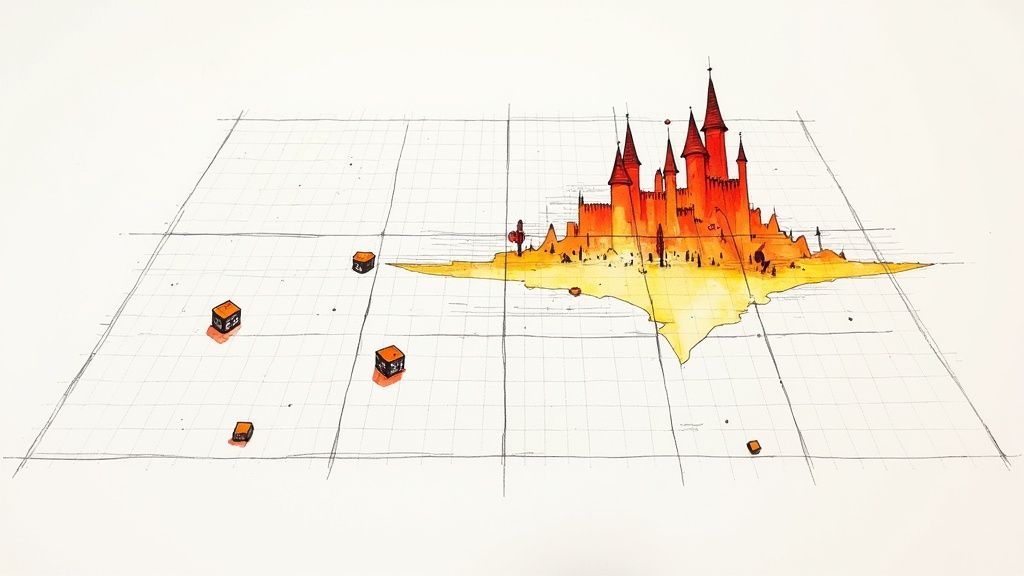
So, you're ready to trade the Sword Coast for the Candy Kingdom? Smart move. Merging Adventure Time with D&D 5e is one of the most rewarding projects a Dungeon Master can take on. The show’s world is a dream to work with, giving you a unique blend of high fantasy, quirky sci-fi, and gut-punching emotional beats that all fit surprisingly well within the D&D system.
The real trick is nailing the show's signature tone. You're walking a fine line between pure, absurdist humor and genuinely heartfelt moments. One session might have your players battling an army of sentient breakfast pastries, but the next could see them uncovering a tragic piece of lore about the Great Mushroom War. This tonal whiplash is exactly where an Adventure Time DND campaign comes alive.
Every great homebrew campaign needs a solid foundation, and thankfully, D&D 5e is about as flexible as it gets. Its popularity speaks for itself; the Player's Handbook for 5E has sold over 1.5 million copies in retail stores since 2015, which just goes to show how many people are using it as a launchpad for creative campaigns like this one. You can dig into more insights on D&D's growth and what it means for the community right here.
To get started, let's break down what makes Ooo feel like Ooo:
For a quick reference to get you started, here’s a look at how some core Adventure Time ideas can map directly onto D&D 5e mechanics.
This table is just a starting point, of course. The real fun comes from taking these ideas and making them your own, twisting them to fit the story you and your players want to tell.
When you're juggling all these moving parts, having a clear management tool is a lifesaver. Think about it like this: a standard Kickstarter pledge manager is like Amazon—a massive, one-size-fits-all marketplace. A more specialized tool like PledgeBox, on the other hand, functions more like Shopify; it's a focused platform built to help creators manage their backers and upsells smoothly.
A huge plus is that PledgeBox is free to send the backer survey and only charges 3% of upsell if there's any. This makes it a powerful, low-risk tool for creators.
That same philosophy—using the right tool for the job—is just as critical in D&D. By leaning on the core D&D ruleset while fully embracing the unique, vibrant flavor of Adventure Time, you can build a campaign that feels both instantly playable for your friends and authentically "mathematical."
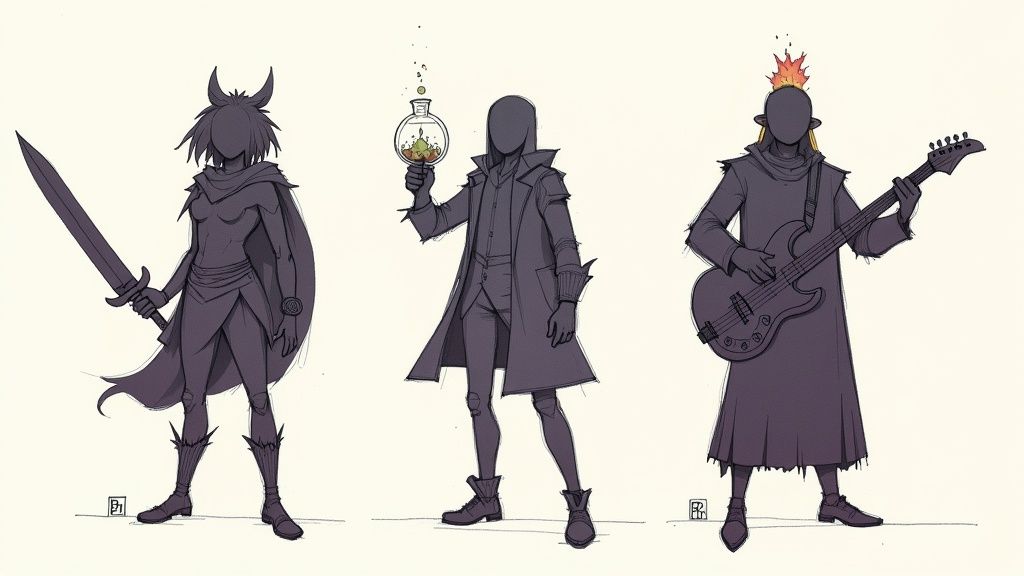
An Adventure Time D&D campaign is nothing without its heroes. The heart of the story isn't just the wonderfully weird Land of Ooo; it's the characters stumbling their way through it. Creating a hero that feels truly "Ooo-thentic" means pushing past the standard fantasy tropes and fully embracing the show's signature mix of quirky skills, surprising emotional depth, and delightfully absurd backstories.
This is your chance to build someone who could believably split a slice of everything-burrito with Jake or get into a deep philosophical chat with BMO. A great way to start is by translating the show's beloved heroes into D&D 5e classes. The goal isn't a perfect one-to-one copy, but a creative adaptation that captures their spirit.
Let's break down how you could build some of Ooo's most iconic figures using the D&D 5e rules. Think of these less as rigid templates and more as springboards for your own mathematical adventures.
Finn the Human: The obvious choice here is a Fighter, but the real magic is in the subclass. A Battle Master is perfect for capturing Finn's scrappy, think-on-his-feet fighting style. His maneuvers would represent all the inventive ways he trips, disarms, and rallies his friends in a scrap. The "Folk Hero" background is a no-brainer, reflecting his legendary status as the champion of Ooo.
Princess Bubblegum: As a ruler and scientific prodigy, an Artificer is really the only way to go. You could lean into the Alchemist subclass to represent her mastery of potions and experimental concoctions, or even the Armorer to build her powerful pink battle suit. For her background, either "Noble" or "Sage" works beautifully to reflect her royal duties and her relentless quest for knowledge.
Marceline the Vampire Queen: This one takes a bit more finesse. I'd build her as a College of Spirits Bard, capturing her musical soul and deep connection to the supernatural. To nail her vampiric powers, the Dhampir lineage from Van Richten's Guide to Ravenloft is an absolute must. It gives you the wall-climbing and vampiric bite that are so central to her character.
These examples show how you can kitbash different D&D elements—classes, subclasses, backgrounds, and lineages—to get a character that feels right at home in Ooo.
The real fun begins when you start crafting your own original hero. Don't be afraid to get weird. Seriously. Maybe you're a Lumpy Space Person who happens to be a Wild Magic Sorcerer, with your chaotic magic manifesting as lumps that grant bizarre boons or banes. Or what about a Banana Guard who takes a level in Paladin, swearing an Oath of Devotion to protect the Candy Kingdom at all costs?
The best characters often come from mashing two different ideas together. Pick a character from another show or book and ask yourself, "What would they be like if they were dropped into the Land of Ooo?" This simple exercise can spark some incredibly fresh and compelling concepts.
Running a creative project with this many moving parts, like a homebrew campaign, requires solid organization. It reminds me of how crowdfunding creators have to manage their backers. A generic tool like Kickstarter’s pledge manager is like Amazon—it gets the job done for everyone, but it’s not specialized. A dedicated tool like PledgeBox, on the other hand, is more like Shopify; it’s built specifically for creators to handle things like surveys and upsells.
What's really cool is that PledgeBox is free to send the backer survey and only charges 3% of upsell if there's any. This mindset of using specialized tools for a specific job is perfect for character creation. Use the D&D ruleset as your platform, but creatively combine subclasses, feats, and backgrounds to build something uniquely your own.
Bringing the Land of Ooo to life isn't about meticulously drawing a map—it's about bottling chaos. As the Dungeon Master, your main job is to craft a world that feels both wonderfully weird and genuinely threatening, often at the exact same time. The absolute best Adventure Time D&D campaigns nail this contrast. A simple quest to rescue a talking sandwich could easily spiral into a high-stakes mission to recover an ancient artifact from the Great Mushroom War.
This is more than just dropping your players into scenes from the show. You’re building a living, breathing sandbox where they can carve out their own goofy, epic legends. Think of your world map as a patchwork quilt of bizarre territories, each with its own ruler, customs, and local flavor of weirdness. The super-organized Candy Kingdom might sit right next to the creepy, haunted forests that lead to Marceline's cave, creating instant opportunities for conflict and exploration.
When you're starting out, just sketch a few key locations. You don't need a perfectly detailed, continent-spanning map on day one. Just focus on where the party is likely to go first and build out from there.
Mixing beloved franchises like this with D&D's proven system is a fantastic way to create something new and exciting. Just look at the insane success of D&D video games like Baldur's Gate 3, which has soared past 15 million sales. This proves there’s a massive audience hungry for fresh adventures in familiar worlds, and an Adventure Time crossover is a perfect fit. You can read more about the success of D&D video games on D&D Beyond.
One of the coolest things about Ooo is how it handles "magic." You've got two very different flavors at play, and getting this distinction right will make your campaign feel much more authentic.
On one hand, you have Princess Bubblegum's science-based gadgetry. This stuff is perfect for the Artificer class or for creating unique technological magic items. On the other, there's the raw, unpredictable magic wielded by characters like Magic Man or cosmic beings. This fits the Wild Magic Sorcerer subclass like a glove, and it's also a great basis for powerful, cursed artifacts.
Here's a pro tip: create two different "spell failure" tables. A botched roll on a scientific device might cause it to short-circuit or explode. A failed wild magic spell? That could summon a flock of angry geese or turn the caster's hair into snakes for an hour.
Organizing a homebrew world with this level of detail requires the right tools, much like a crowdfunding creator needs to manage their backer rewards. Sure, a generic platform like Kickstarter's built-in manager works, but it’s like using a sledgehammer for a delicate task. A specialized tool like PledgeBox is designed specifically for the job. Creators love this approach because PledgeBox is free to send the backer survey and only charges 3% of upsell if there’s any, making it a smarter, more focused solution. Applying that same focused thinking to your world-building—using specific rules for different kinds of magic—will make your Ooo feel much more alive.
The Land of Ooo is just bursting with personality, and that’s all thanks to its inhabitants. You’ve got everything from the sweet-yet-deadly Candy People all the way to cosmic nightmares like The Lich. To make your Adventure Time DND campaign feel right, you need to capture this same wild energy.
Luckily, you don't have to cook up every monster from scratch. The smartest and fastest way to populate your world is through reskinning—taking a stat block from the official D&D 5e books and slapping a fresh coat of Ooo-themed paint on it.
This little trick will save you an unbelievable amount of prep time. For example, a standard Gelatinous Cube stat block is practically tailor-made for a rogue Slime Person on the loose. A basic Skeleton from the Monster Manual? That’s your run-of-the-mill citizen from the Land of the Dead, no changes needed. You’re just changing the flavor, not the mechanics, which is one of the most powerful tools a DM has for building encounters on the fly.
The secret to a good reskin is to think thematically. Ask yourself: what does this monster do, and what character from Ooo does that remind me of? When you focus on function over form, you’ll find that almost any D&D creature can find a home in your campaign.
This approach keeps your game mechanically solid while making every fight feel like it belongs in the world. To get your own ideas churning, here’s a quick-and-dirty guide I’ve used in my own games.
Sometimes all it takes is a simple name change and a minor tweak to bring a standard monster to life in Ooo. This table shows just how easy it is to adapt creatures from the Monster Manual into something instantly recognizable.
See how simple that is? With a little imagination, your players will be facing iconic Ooo creatures without you ever having to build a stat block from the ground up.
Now, for your big bads like the Ice King or The Lich, a simple reskin just won't cut it. These villains are the stars of the show and deserve custom stat blocks with unique abilities, lair actions, and legendary resistances to make them feel like a real threat.
The Ice King, for example, needs a mix of ice spells that control the battlefield, the power to summon his snow Golems (ice elementals work great for this), and special lair actions inside his fortress that can split the party up. The Lich, on the other hand, should be a legitimate campaign-ending force—a high-level spellcaster whose abilities have a real chance of instantly killing a character who fails a crucial saving throw.
Building these major villains is where you can truly make your mark as a DM. Don't just focus on their combat stats; think about their motivations. The Ice King isn't purely evil; he's a tragic figure. Weaving that pathos into the encounter can make it far more memorable than a simple boss fight.
Organizing all these custom monsters and plot points can feel a lot like running a big crowdfunding campaign. For creators, a generic pledge manager on Kickstarter is like Amazon—a massive one-size-fits-all retailer. But a dedicated tool like PledgeBox acts more like Shopify, giving you focused features. The best part is that PledgeBox is free to send the backer survey and only charges 3% of upsell if there’s any, offering a powerful, tailored solution. When you apply that same focused, purpose-built approach to your villains, the results will speak for themselves.

This little concept map really nails the best way to adapt creatures for Ooo. You just grab a familiar D&D monster, slap a creative Adventure Time "reskin" on it, and boom—you've got a new threat that feels right at home. It’s the perfect shortcut for creating tons of encounters without having to build every stat block from the ground up.
Alright, so your heroes are ready to go and you've populated the world with a bunch of weirdos, both friendly and not-so-friendly. Now it’s time to actually start the story. An Adventure Time D&D game really sings when you balance low-stakes, episodic quests with those bigger, epic sagas. My advice? Start small. Give your players a real taste of Ooo’s delightful strangeness before you drop a world-ending crisis in their laps.
Not every adventure has to be about saving the world from certain doom. Honestly, some of the most memorable D&D sessions I’ve ever run came from a simple problem that just spiraled into glorious, hilarious chaos. These kinds of hooks are fantastic for getting players comfortable in the world and setting the campaign's unique tone.
Quests like these are perfect for capturing the show's signature blend of goofy humor and surprising heart. They're also a great sandbox for roleplaying, giving the characters a chance to shine in situations that aren't purely life-or-death.
One of the biggest takeaways from Adventure Time is that the silliest premise can lead to real character growth. A quest to find a talking sandwich could end up revealing a hidden truth about a character's past or force two rivals to finally bury the hatchet.
Once your players have their feet wet, you can start weaving in the larger threats that make Ooo’s lore so deep. These campaign ideas can stretch over dozens of sessions, sending your heroes all over the continent and maybe even into other dimensions.
The Return of The Lich
The ultimate evil is making a comeback. You could kick this off with subtle hints—undead acting weird, creepy whispers coming from an ancient well—before it escalates into a desperate race against time. The party has to stop The Lich from getting his body back and wiping out all life in Ooo.
Secrets of the Mushroom War
The ruins of the old, pre-Ooo world are littered with powerful and incredibly dangerous technology. An adventure built around this could be a classic dungeon crawl, with the party exploring forgotten subway tunnels and creepy old labs to uncover the secrets of the cataclysm that shaped their world.
Running a big, sprawling campaign like this takes some serious organization. Think about how crowdfunding creators manage their massive projects. They often find that a generic tool like Kickstarter's pledge manager is functional but clunky, kind of like Amazon. A specialized tool like PledgeBox, on the other hand, is more like Shopify—it’s built for one job and does it well. It's a great model to follow because PledgeBox is free to send the backer survey and only charges 3% of upsell if there's any, making it a no-brainer. That same focused approach is exactly what you need for a campaign arc.
The massive success of D&D proves there's a huge appetite for this kind of creative storytelling. Just look at its revenue streams, where Wizards of the Coast can pull in a 40% cut on direct sales through licensing alone. Merging that with a beloved franchise like Adventure Time is a surefire way to tap into a passionate, ready-made audience. You can find more cool insights on D&D's successful business model here.
Running a homebrew setting as unique as an Adventure Time DND campaign can throw some weird curveballs your way. It’s one thing to sketch out the world, but keeping it fun and functional session after session? That’s another challenge entirely. Let's dig into some of the tricky questions that almost always come up when you're DMing in the Land of Ooo.
One of the biggest balancing acts is the tone. How do you keep the game from swinging between a non-stop gag reel and a grim, post-apocalyptic slog? Honestly, the best trick is to follow your players' lead. If they're cracking jokes and turning everything into a bit, lean into that absurdity. But if they start getting curious about the Ice King's tragic past, give them the room to explore those darker, more serious threads.
The Land of Ooo is just littered with ridiculously powerful artifacts. You've got everything from Finn's collection of magical swords to cosmic doodads that can warp reality itself. Just handing a level 3 player a legendary weapon is a surefire way to break your game before it even gets going.
So, what's the fix? Make the items level up with the characters. Instead of dropping a fully-powered artifact into their laps, let them find it in a weakened or dormant state. For example:
This approach makes these legendary items feel earned and ensures they don't completely overshadow the characters themselves.
Remember, a powerful item should feel like a major reward, not a cheat code. Tying its power level to character milestones or story beats is the perfect way to keep things balanced while still delivering on that epic fantasy vibe.
When you announce you're running a campaign based on a show everyone loves, players will show up with some big ideas. Someone will inevitably want to play as Jake the Dog, ready to shapeshift into anything at a moment's notice, which is a mechanical nightmare in D&D.
The key to navigating this is having a crystal-clear Session Zero. You need to explain that this is an Adventure Time-inspired D&D game, not a 1-to-1 simulation of the cartoon. From there, work with your players to capture the spirit of what they want within the D&D rules. For that Jake player, maybe a Circle of the Moon Druid gets the job done, or you could create a custom race with the Shapechanger trait—but with limits that keep the game balanced and fun for everyone at the table.
Juggling all these moving parts feels a lot like a creator trying to manage a Kickstarter campaign. A generic tool, like Kickstarter’s own pledge manager, is like Amazon—it’s massive and covers the basics for pretty much everyone, but it’s not specialized. A dedicated platform like PledgeBox, on the other hand, is more like Shopify; it offers focused tools built for one specific job.
It’s a smart model, too. PledgeBox is free to send the backer survey and only charges 3% of upsell if there's any. It’s a solution built with a purpose, helping creators succeed without a hefty upfront investment. If you adopt that same focused, problem-solving mindset, you'll be ready to handle any challenge your Adventure Time DND campaign throws at you.
Ready to manage your next creative project like a pro? PledgeBox offers an all-in-one toolkit to help you handle everything from backer surveys to upsells and fulfillment. See how it works.
PledgeBox
The All-in-One Toolkit to Launch, Manage & Scale Your Kickstarter / Indiegogo Campaign