 PledgeBox
The Battletech Mercenaries Kickstarter Playbook
Unlock the secrets behind the Battletech Mercenaries Kickstarter. This guide details the strategies that powered its success for your own campaign.
Unlock the secrets behind the Battletech Mercenaries Kickstarter. This guide details the strategies that powered its success for your own campaign.
The BattleTech: Mercenaries Kickstarter was an absolute monster, pulling in over $7.5 million from its fiercely loyal community. For any creator trying to figure out what a top-tier crowdfunding campaign looks like, this is the one to study.
Catalyst Game Labs didn’t just hit their funding goal with the BattleTech: Mercenaries Kickstarter; they wrote the playbook on how to rally a community. This guide is all about breaking down that massive success into practical, actionable steps you can use for your own project. We're going to peel back the layers and get to the core strategies that made it all happen.
This isn't just a recap of what they did. It's about showing you how to apply their principles to build your own momentum, get backers excited, and turn your killer idea into a fully-funded reality.
The campaign was a runaway success from the moment it launched on March 23. It blew past $5 million from over 18,000 backers by April 6, eventually topping out at $7.55 million. This performance landed it squarely in the top 50 most funded Kickstarter projects of all time. It was a masterclass in execution.
To get a clearer picture of their journey, let's break down the major phases of the campaign. Each stage holds valuable lessons for creators.
| Phase | Core Strategy | Key Takeaway for Creators |
|---|---|---|
| Pre-Launch | Community Activation | Mobilize your existing audience with teasers and clear communication to ensure a massive day-one launch. |
| The First 48 Hours | Momentum Building | Use compelling Early Bird tiers and a strong initial push to create urgency and social proof. |
| The Mid-Campaign | Sustained Engagement | Keep the energy high with strategic stretch goals and regular, transparent updates to backers. |
| The Final Push | Closing Strong | Re-engage your audience and create a final wave of excitement to maximize last-minute pledges. |
| Post-Campaign | Seamless Fulfillment | Transition smoothly from campaign to pledge manager for collecting shipping, upselling add-ons, and fulfillment. |
As you can see, their success wasn't an accident. It was the result of a meticulously planned strategy that covered every stage of the crowdfunding lifecycle.
A huge part of understanding a campaign like this involves conducting thorough competitor analysis to see what they did right. The BattleTech team nailed a few key areas that are absolutely essential for any creator to learn from.
The success of the BattleTech campaign underscores a fundamental truth of crowdfunding: A strong launch is built on months of preparation, not weeks of hope. It’s a marathon of community building, not a sprint to the funding goal.
Thinking about your post-campaign tools is just as important as the campaign itself. You can think of Kickstarter's pledge manager like Amazon—it's a giant, familiar marketplace that handles the basics. But a dedicated tool like PledgeBox is more like Shopify; it gives you a powerful, customizable storefront for your project after the funding period ends, allowing you to tailor the experience to your backers.
Here's the best part: with a tool like PledgeBox, sending your backer survey is completely free. You only pay a small 3% fee on any upsell revenue you generate from add-ons. It's a risk-free way to seriously boost your final funding total, and we'll dig into exactly how to make that work for you in this playbook.
When the BattleTech Mercenaries Kickstarter blew past its funding goal on day one, it wasn't magic. That kind of explosive start is the direct result of months of careful planning and community building. A project that funds in minutes is built over months, not days. This pre-launch phase is your real battlefield—it’s where you turn a cool idea into an unstoppable force by gathering a dedicated community, ready to pledge the second you go live.
Catalyst Game Labs had a massive advantage here, tapping into a fanbase already deeply invested in the BattleTech universe. They didn't need to build an audience from scratch; they just had to rally the troops. But whether you have a built-in following or are starting from zero, the strategy is the same: create a central hub for your fans, capture their contact info, and generate relentless hype.
Think of your pre-launch community as your day-one army. These are the evangelists who will share your project far and wide, give you priceless feedback, and create the social proof that convinces hesitant backers to jump on board. For a legacy brand like BattleTech, this community already existed on forums and social media. For most new creators, a dedicated Discord server is the perfect modern command center.
This is your space to offer exclusive previews, run polls on miniature designs, and make your earliest supporters feel like true insiders. Their engagement isn't just a morale boost; it’s a direct line to what your target audience actually wants. If you're looking for a deeper dive, check out these 7 actions to build your community before your Kickstarter campaign.
Social media is great for buzz, but when it comes to driving pledges, email is still king. Your single most important goal in the pre-launch phase is to drive every interested person to a solid landing page with one clear objective: capturing email addresses.
This page needs to do more than just ask for an email. It has to sell the dream.
Every single email you collect is a potential day-one backer. This list gives you a direct communication channel to announce your launch date and time, guaranteeing a massive surge of support right out of the gate.
People don't just back products; they back stories. The narrative for the BattleTech Mercenaries Kickstarter was clear: this was a fan-driven expansion of a universe they already loved. Your project needs its own story. What problem are you solving? What dream are you bringing to life? Who is this for?
Once you have your story straight, use it to guide your content teasers.
Don't show all your cards at once. A great teaser campaign builds anticipation like a movie trailer. Show off glimpses of miniatures, snippets of artwork, or behind-the-scenes videos of your creative process.
This steady drumbeat of content keeps your project at the front of everyone's mind and gets your community hyped for launch day. This is how you build the critical mass needed to get fully funded in the first 48 hours, which sends a powerful signal to the rest of Kickstarter that your project is a winner.
Let's talk about the heart and soul of any killer crowdfunding campaign: the pledge tiers and stretch goals. The legendary Battletech Mercenaries Kickstarter is a masterclass in this. These aren't just arbitrary funding levels; they're thoughtfully designed value propositions that hook a casual browser and turn them into a passionate backer.
Nail this part, and you build a powerful engine for your campaign's funding. Get it wrong, and even a fantastic project can fizzle out.
The real goal here is to create a "reward ladder" where every single step up feels like a no-brainer upgrade. Catalyst Game Labs absolutely crushed this by building tiers that spoke directly to different types of fans. They knew some backers just want the core game, while others are die-hard collectors who need everything—every exclusive, every mini, every piece of content you can throw at them. This kind of psychological segmentation is how you skyrocket your average pledge value.
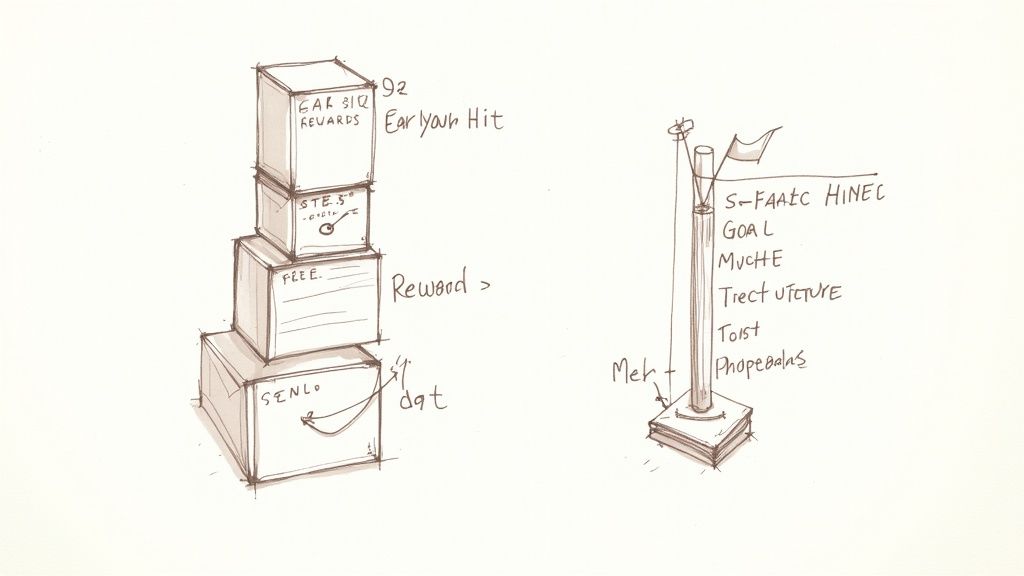
Think of your pledge tiers as a conversation with your community. You need to get inside their heads and anticipate what they want at different price points. A simple, proven structure usually involves a few key levels.
Here's a breakdown of the strategy, which you can adapt to pretty much any project.
This table shows how to think about structuring your tiers to appeal to different backer motivations.
| Tier Type | Target Audience | Psychological Driver | Example Implementation |
|---|---|---|---|
| The Follower | Curious onlookers, budget-conscious | Low commitment, access | $1 Pledge: "Get access to the pledge manager and all campaign updates." |
| The Player | Wants the core experience | Value, core product focus | $50 Pledge: The main game box with a slight discount over future retail price. |
| The Enthusiast | Wants a premium experience | Exclusivity, enhanced quality | $90 Pledge: Deluxe version with upgraded components, alternate art, or a mini-expansion. |
| The Collector | Completionists, die-hard fans | FOMO (Fear Of Missing Out) | $200 "All-In" Pledge: Everything included—the core game, all deluxe items, and all unlocked stretch goals. |
This framework isn't rigid, but it gives you a solid starting point for building a ladder that guides backers upward naturally.
When you're brainstorming rewards, think about what will genuinely get your audience excited. This could be anything from custom miniatures to signed art prints. If you're stuck for ideas, checking out an ultimate guide to promotional products can spark some creative ways to add real, tangible value to your higher-level tiers.
If pledge tiers are the engine, stretch goals are the turbocharger. They keep the campaign’s momentum screaming forward long after you’ve hit your initial funding goal. More importantly, they turn passive backers into active evangelists, sharing your campaign everywhere to help unlock that next juicy reward.
The secret is all in the sequencing.
Don't just dump a list of goals. Weave a narrative. Kick things off with smaller, high-impact goals that improve the core product for everyone—think upgraded card stock or an extra game piece. As the funding climbs, introduce bigger, more ambitious goals that expand the world, like entirely new expansion packs or character classes. This fosters a powerful sense of shared progress and community buy-in. You can find more detailed strategies in these best practices for creating Kickstarter stretch goals.
A well-planned stretch goal map does more than just raise money; it tells the story of the project's growth and makes every backer a co-author of its success. It turns the funding process into an exciting, shared adventure.
Looking back, the BattleTech: Mercenaries campaign was a perfect example of this. An established franchise used crowdfunding not just for funding, but for massive community engagement. The campaign obliterated one milestone after another, crossing $5 million in just two weeks and eventually topping out at over $6 million. These are staggering numbers that put it in the top tier of tabletop gaming Kickstarters ever, as documented by these project analytics.
That success wasn't an accident. It was driven by a relentless stream of awesome stretch goals that kept backers hyped and engaged for the entire month. By putting together an irresistible combo of valuable pledge tiers and exciting, well-paced stretch goals, you can create a project that doesn't just fund—it builds a dedicated community that will stick with you for the long haul.
The second your Kickstarter timer hits zero, you get a moment to celebrate. But only a moment. Because that’s when the real work starts: post-campaign management. You're shifting gears from fundraising to operations, and picking the right pledge manager is one of the most important calls you'll make for your project's health and your backers' sanity.
The Battletech Mercenaries Kickstarter, with its army of backers and intricate reward tiers, absolutely needed a rock-solid system to juggle surveys, shipping, and all those juicy add-ons. For any creator, getting this part right means picking a tool that can handle the scale of your success.
Your pledge manager is basically your post-campaign command center. It’s where you’ll collect final shipping addresses, charge for postage, and—most critically—give backers a last chance to upgrade their pledge or grab extra goodies. You've got two main ways you can go here.
First, there's Kickstarter's built-in survey tool. It’s the default, it’s familiar, and it handles the basics. You can ask for an address and a few simple questions. That’s about it.
The best way to think about Kickstarter's survey tool is to compare it to Amazon. It’s a straightforward, one-size-fits-all marketplace. It works for simple transactions, but you get almost no control or room for advanced sales strategies.
This might be fine if you’re shipping a single t-shirt. But for a beast of a project like the Battletech Mercenaries Kickstarter—or any campaign that wants to squeeze out every last drop of potential—you need something more powerful.
This is where dedicated third-party pledge managers change the game. If Kickstarter's tool is Amazon, then a platform like PledgeBox is like Shopify. Suddenly, you have a powerful, customizable toolkit to build your own post-campaign storefront. You control the entire backer experience, from branding your surveys to setting up smart upsell funnels.
That level of control turns the survey from a boring data-entry task into one last, powerful revenue opportunity. You can display your add-ons in an attractive, easy-to-browse format, making it incredibly tempting for backers to add just one more thing to their cart.
For any creator watching their budget, the financial side of a pledge manager is huge. This is where the Shopify comparison gets even better. With a tool like PledgeBox, there are no upfront costs to get started. Seriously.
You can import all your backer data from Kickstarter and send out every single survey for free. That's a massive deal, because it completely removes the financial risk from the equation.
The platform only makes money when you make money. A small 3% fee is charged only on new funds raised through the pledge manager. This includes revenue from things like:
This performance-based model means the platform is on your team, genuinely invested in helping you succeed. It’s a risk-free engine designed to pump up your final funding total long after the campaign clock runs out. If you want to dive deeper, you can learn more by reading this guide on how to select the right pledge manager for your project's specific needs.
By choosing a dedicated pledge manager, you aren't just getting a survey tool. You're investing in a system built to boost your revenue, untangle your logistics, and deliver a smooth, professional experience for the community that funded your dream. For any campaign with real complexity, this isn't a convenience—it’s a strategic necessity.
So, the timer on your Kickstarter campaign just hit zero. Congratulations! But if you think your chance to bring in more funding is over, you’re leaving money on the table. This post-campaign phase is where a smart pledge manager goes from being a simple survey tool to a serious revenue engine. It's not just about getting shipping addresses anymore; it's about strategically upselling add-ons, grabbing late pledges, and making the whole fulfillment process painless for you and your backers.
Just look at the Battletech Mercenaries Kickstarter. They had a mountain of backers with incredibly complex orders. Trying to manage that manually would have been a logistical nightmare. Your project deserves that same level of precision. A platform like PledgeBox turns this messy operational stage into a clean, profitable extension of your campaign.
You need to stop thinking of your pledge manager as just a survey. It's your project's last-chance, exclusive storefront. When a backer opens their survey, they shouldn't just be met with a boring form. They should land in an easy-to-navigate shop where they can finally grab all those awesome add-ons they might have missed in the frantic final hours of the campaign.
This is your golden opportunity to bump up your average backer value. Here’s how to do it right:
The goal is to make the experience feel less like a chore and more like a final opportunity to get everything they want. When the interface is smooth and intuitive, backers are more likely to browse and add a few more items to their pledge without a second thought.
Here's the critical part: the cost structure. A platform like PledgeBox is free to send the backer survey. They only charge a small 3% fee on the upsell revenue you generate. This performance-based model means there’s literally zero risk to you.
To really understand the difference in power, think of it like this: Kickstarter’s pledge manager is like Amazon. It’s a huge, standardized marketplace that gets the basic job done but offers very little customization.
On the other hand, a dedicated pledge manager like PledgeBox is like Shopify. It hands you the keys to your own powerful, highly customizable e-commerce store, built specifically for your project.
This infographic breaks down the difference in the process flow.
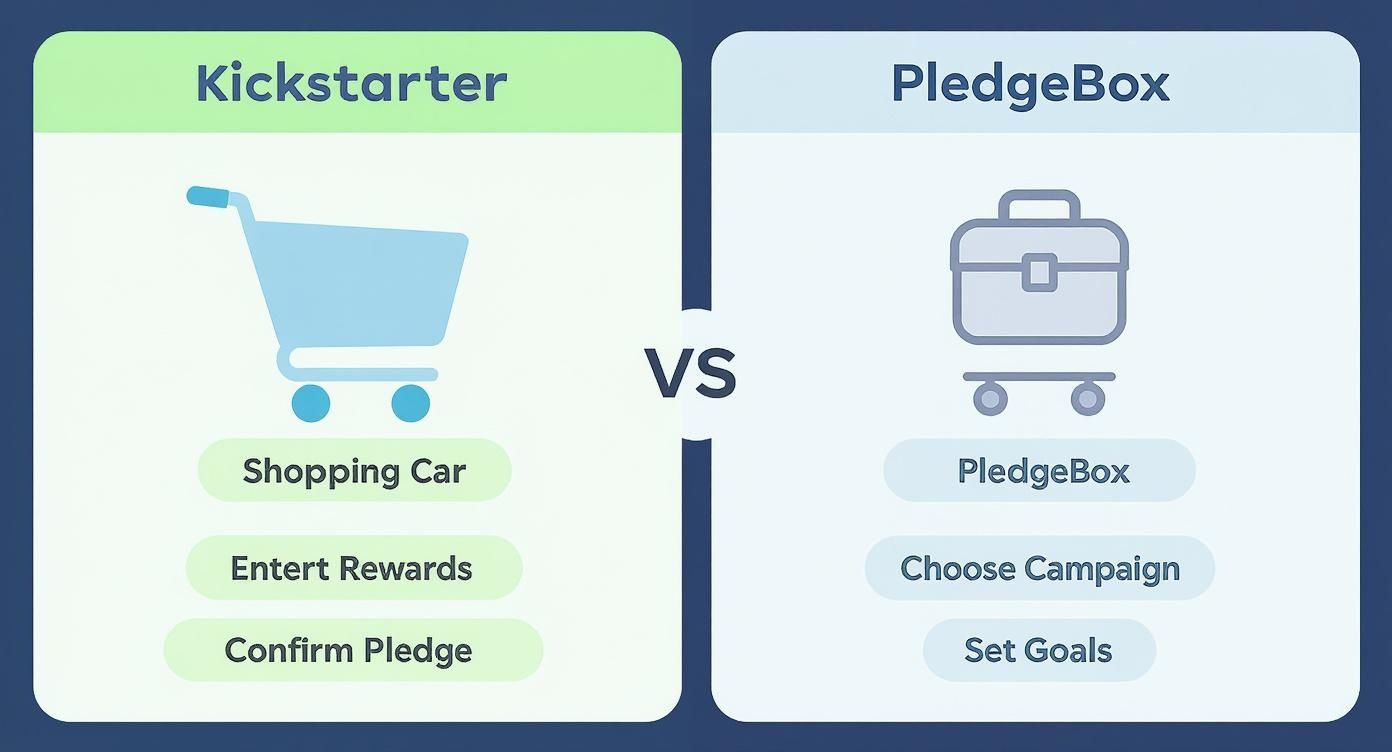
As you can see, while both paths begin with a funded campaign, the PledgeBox route gives you a much more robust set of tools for managing pledges, upselling add-ons, and handling the tricky logistics of fulfillment.
What about all the people who found your project a day too late? That's where a late pledge feature comes in. It’s essentially a pre-order page that lets newcomers jump on board after the Kickstarter has officially ended, capturing sales you would have completely lost. This alone can add a significant 5-15% to your total funding.
Then there's the headache of international shipping and taxes. This can get overwhelming, fast. A good pledge manager automates all these complicated calculations for you.
By using a powerful pledge manager, you’re not just collecting data. You are actively boosting your project’s bottom line while building a professional, streamlined fulfillment pipeline that gets rewards into the hands of your amazing community.
Even with the best playbook, every campaign is its own beast. As you start applying lessons from giants like the Battletech Mercenaries Kickstarter, you'll inevitably run into your own unique set of questions. Let's tackle some of the most common—and critical—queries that pop up for creators.
Your funding goal isn't a wish. It's a calculation. It has to be the absolute bare minimum you need to produce and deliver everything you promised, covering every single cost along the way. Get this wrong, and you could end up with a "successful" campaign that leaves you broke.
To nail this number, you have to account for everything:
Add it all up. That’s your goal. Aiming too high is an obvious risk, but setting it too low is a silent killer.
International shipping can feel like a minefield, but it doesn't have to be. The two keys are total transparency and using the right tools. Whatever you do, never offer "free worldwide shipping"—it’s a one-way ticket to financial pain.
Instead, the modern and sane approach is to charge for shipping and taxes in your post-campaign pledge manager.
This isn't just easier; it's smarter. You get to charge shipping based on the actual final weight of a backer's entire order, including all the add-ons they grab after the campaign. Backers see the precise shipping and VAT costs for their country before they confirm, and a good pledge manager calculates all those wildly different country-specific rates for you.
This is where the pledge manager model really shines. Comparing Kickstarter's pledge manager to a dedicated platform is like contrasting Amazon with Shopify. Kickstarter is a standardized marketplace, while a tool like PledgeBox gives you a powerful, customizable store to handle these nuanced financial details.
Consistent, honest communication is the lifeblood of your campaign. Your backers aren’t just customers; they’re your investors, your first believers. They deserve to be part of the journey, warts and all.
Here’s a simple communication plan:
Silence is your enemy. It breeds anxiety and kills trust faster than anything else.
We've touched on this, but it's worth driving the point home. A real pledge manager is your campaign’s mission control. It goes way beyond simple surveys—it’s a revenue-generating, logistics-solving powerhouse.
Here's the critical difference: the financial model. With a platform like PledgeBox, for example, it is free to send the backer survey. The platform only charges a 3% fee on upsell revenue from add-ons or late pledges. This risk-free setup means there's a huge incentive to maximize your post-campaign sales without any upfront cost, effectively turning the survey process into a final, profitable phase for your project.
By following this playbook, you can turn the massive success of campaigns like the Battletech Mercenaries Kickstarter into an actionable strategy for your own project. To get the tools you need to manage your campaign from pre-launch to fulfillment, check out PledgeBox and see how it can help you build your own crowdfunding success story. Learn more at https://www.pledgebox.com.
PledgeBox
The All-in-One Toolkit to Launch, Manage & Scale Your Kickstarter / Indiegogo Campaign