 PledgeBox
Board Game Kickstarter Your Winning Campaign
Launch a successful board game Kickstarter. Our guide covers pre-launch, campaign strategy, pledge managers, fulfillment, and real creator insights.
Launch a successful board game Kickstarter. Our guide covers pre-launch, campaign strategy, pledge managers, fulfillment, and real creator insights.
Launching a board game Kickstarter is an incredible journey. You’re taking that creative spark—that game you've poured your heart into—and turning it into a real, physical product that will land on tables all over the world. It’s a marathon that blends passionate game design with sharp business strategy, but the reward is seeing your idea become a funded, tangible reality.
So, you're ready to launch your board game on Kickstarter? Awesome. This guide is your practical roadmap, cutting through the theory to give you real, actionable strategies for navigating the crowded tabletop scene. We'll walk through the entire process, from polishing your concept to managing a funded project and, finally, getting those games into your backers' hands.
Success here boils down to three things: smart planning, genuine community building, and rock-solid logistics after the campaign ends. Think of your Kickstarter as more than just a fundraiser; it's a full-blown product launch. Treating it like one and having a structured modern product launch plan from the get-go will give you a massive advantage.
Kickstarter completely changed the game for independent creators when it arrived in 2009. Since then, over $778 million has been pledged to game projects alone, letting designers like you skip the traditional publisher route and connect directly with players. The numbers don't lie: around 57% of board game fans have backed at least one campaign, with Kickstarter being their go-to platform.
To get a clearer picture of the journey ahead, let's break down the key stages. A successful campaign is much more than just the 30 days it's live.
This infographic lays out the three core phases you'll go through, from the initial idea all the way to final fulfillment.
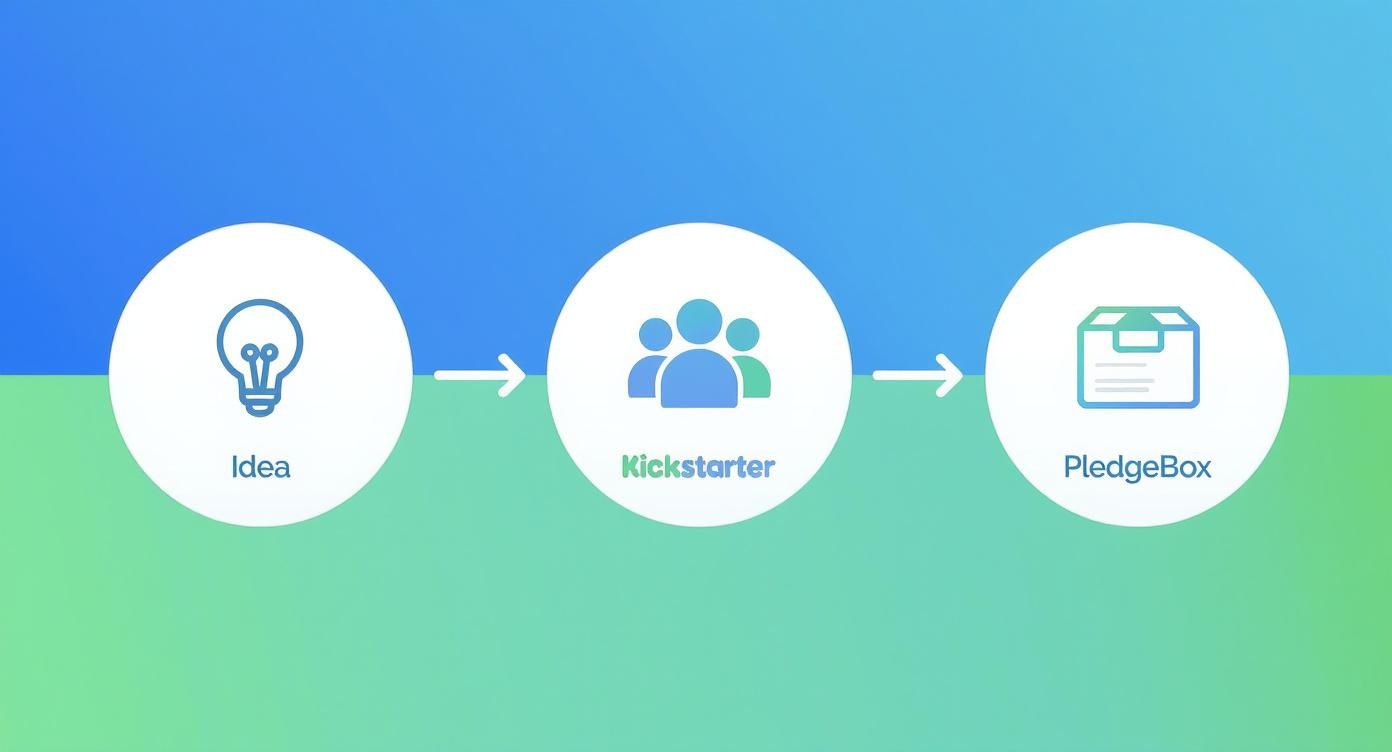
As you can see, the live campaign is just the middle piece of the puzzle. The real heavy lifting happens before you launch and long after the funding clock runs out.
To simplify the process, here's a quick look at how these phases break down into actionable steps.
Each phase is distinct and requires a different focus, but they all flow into one another. Getting the pre-launch right sets you up for a strong campaign, which in turn makes the post-campaign phase much smoother.
One of the most important things to understand early on is how different platforms fit into your strategy. I've found this analogy really helps clarify their roles:
This distinction is crucial. Kickstarter gets the money in the door; a pledge manager like PledgeBox ensures you can deliver on your promises efficiently and keep your backers happy. Internalizing this from day one will sharpen your entire strategy.
What’s great is that PledgeBox makes this whole post-campaign process incredibly accessible. It’s completely free to send your backer surveys and collect everyone's shipping info. They only take a small 3% fee on new funds raised from upsells, if there's any, which means the platform literally pays for itself by helping you generate more revenue. This model removes a huge financial barrier for creators while giving you the professional tools you need.
And if you’re still in the early stages, our guide on crafting your crowdfunding prototype is a great place to start.
The most successful board game Kickstarters don’t just stumble into the spotlight; they launch with a thunderous bang. That huge rush of funding you see on day one? That’s not luck. It’s the result of months of dedicated community building. Honestly, the success of your campaign is often decided long before you ever click "launch."
This pre-launch phase is all about finding your tribe—the players who will not only back your project but shout about it from the rooftops. The goal isn't just to collect email addresses. It's about forging a genuine connection with an audience that's emotionally invested in your game's success from the very beginning.
First things first, you need to figure out where your target audience lives online. For board game lovers, a few platforms are pretty much non-negotiable.
The real key here is to give, give, give before you ask. Answer questions, praise other people's cool ideas, and just share your passion for the hobby. This is how you build trust and become a creator people genuinely want to follow. For a deeper dive, check out our guide on the 7 actions to build your community before your campaign.
As you start gathering followers, you need a central place to direct them. This is where a simple, clean landing page becomes your best friend. This page has one job and one job only: to capture email addresses from people who are excited about your game.
Your landing page should have a few key elements:
This email list is your most powerful asset, hands down. Unlike social media, you own this list. These are the people you can contact directly to announce your launch, guaranteeing that massive wave of support on day one.
Let’s play this out. Imagine you're launching a new fantasy adventure game. About six months before launch, you start posting on BGG, sharing concept art and little snippets from your designer diary. Three months out, you spin up a Discord server and a basic landing page, maybe running a few small, targeted ads to folks who like similar games.
By the time launch day rolls around, you’ve built an email list of 2,000 super-interested fans. You fire off a launch notification email, and within a few hours, your project is already 50% funded.
This initial explosion of activity is a massive signal to the Kickstarter algorithm. It tells the platform, "Hey, this project is hot!" which gets you featured more prominently and shown to brand new backers who are just browsing the site.
This isn't some secret magic trick; it's a proven, repeatable process. That first-day funding surge creates a snowball effect, pulling in organic traffic and showing skeptical visitors that your project is a sure thing.
The growth of crowdfunding for tabletop games is a testament to how powerful this community-first model is. In 2020 alone, the category pulled in roughly $234 million in pledges, a 30% jump from the year before. This incredible growth is driven by creators who master the art of building digital communities, tapping into a cumulative pledge pool for games that has now rocketed past $2.37 billion on Kickstarter.
At the end of the day, a strong pre-launch community de-risks your entire board game Kickstarter campaign. It provides that critical early validation and financial push needed to not just hit your funding goal, but to blow past it with awesome stretch goals, turning a simple product launch into an unforgettable event.
Your Kickstarter page is your digital storefront. It's the single most important piece of real estate for your entire campaign, where a curious browser becomes a committed backer. Every single element needs to work together to build excitement, show off your game's value, and earn trust.
Think of it less as a product listing and more as a compelling story that pulls people into the world you've created. A great page is really an extension of the game itself—it should immerse potential backers in the theme and feel from the moment they arrive. Even the most amazing game won't sell itself; your page has to do the heavy lifting.
People are visual creatures, especially in the world of board games where art and components are a massive part of the appeal. Your page needs to be a visual feast that's also easy to digest.
While stunning visuals grab attention, your words are what will ultimately seal the deal. Your copy should be clear, exciting, and organized for easy scanning. Use headings, bold text, and bullet points to break up those dreaded walls of text.
Your goal is to answer a potential backer's key questions before they even have to ask: What is this game? Why is it unique? Who is it for? And why should I back it right now? For a deeper dive, our article on Kickstarter campaign page design tips is a fantastic resource for honing your message.
Your reward tiers are the financial engine of your campaign, and the psychology behind them is crucial. The goal is to create a funnel that gently guides backers toward your ideal pledge level.
Avoid huge price jumps between tiers. Instead, make each step up feel like a small, logical increase that offers a compelling amount of extra value. A common mistake I see is a basic pledge followed by a massive "all-in" tier that is 2x or 3x the cost—very few backers are going to make that leap.
Consider these tried-and-true structures:
A well-structured set of reward tiers doesn't just present options; it tells a story of increasing value. Each level should make a backer think, "Well, for just a little more, I get that..." This is how you increase your average pledge value and smash your funding goals.
Stretch goals are a fantastic tool for keeping the energy high after you've hit your funding target. But be careful—they can also be a dangerous trap. Poorly planned stretch goals can introduce massive production delays and completely wipe out your profit margins.
A good strategy is to not reveal all your stretch goals at once. Show the first two or three at conservative funding levels. As you hit them, you can reveal more based on the campaign's momentum. This keeps the excitement going and gives you flexibility. Focus on upgrades that enhance the existing game—like thicker cardstock or custom dice—rather than adding entirely new components that complicate manufacturing.
You've hit the launch button, the digital confetti has settled, and your board game Kickstarter is officially live. This is where the real fun—and the real work—begins. Those next 30 days are an all-hands-on-deck marathon that demands your full attention.
Launching is just the starting pistol. Your role instantly pivots from game designer to community manager, marketer, and chief problem-solver. Every day will bring a flood of questions, comments, and chances to connect with the people making your dream a reality. Transparent, proactive communication isn't just nice to have; it's the foundation of a killer campaign.
Staying on top of everything during the funding period is non-negotiable. A simple daily routine can make all the difference, ensuring nothing slips through the cracks and your backers feel seen.
This isn't just busywork; it's how you turn one-time backers into a loyal tribe. This community is more than just a source of funds—they become your most powerful marketing asset. As of early 2025, Kickstarter's platform had more than 24.47 million total backers, and over 8 million of them are repeat supporters. This passionate base is especially powerful in the board game world, where trust and word-of-mouth are everything. You can dig into more details in this Statista report on Kickstarter backers.
Almost every board game Kickstarter hits it: the dreaded mid-campaign slump. After the adrenaline rush of the first few days, funding can slow to a trickle. This is totally normal, but it's not the time to sit back and wait.
Got a surprise stretch goal up your sleeve? Now's the time to reveal it. Holding one or two goals back for this quiet period can inject a fresh wave of excitement and give your community a new target to rally around.
Another great move is to team up with a board game influencer for a live playthrough. A well-timed stream on Twitch or YouTube can put your game in front of a whole new, highly engaged audience, often leading to a noticeable bump in pledges.
The middle of the campaign isn’t a time to coast; it's a time to push. Use this period to retarget interested visitors with ad campaigns, share in-depth gameplay videos, or announce a new, exciting add-on. Active management keeps your project relevant and visible.
Think of Kickstarter as a bustling marketplace like Amazon, where momentum is everything. After the campaign, things shift to a more controlled environment. That’s where a pledge manager like PledgeBox steps in, acting like your own personal Shopify store. It gives you the power to manage fulfillment smoothly and even continue raising funds after the campaign clock runs out.
What makes this transition so easy is the pricing. PledgeBox is completely free to send your backer surveys and collect shipping details. The platform only takes a small 3% fee on any new funds you raise from upsells, if there's any, which means it only makes money when you do—no upfront costs. It’s a powerful toolset designed to help you build a brand that lasts long after your Kickstarter ends.
Congratulations, your campaign is funded! That intense 30-day rush is over, but in many ways, the real work for your board game Kickstarter is just beginning. This is where the project shifts from fundraising to management, and your success now depends on nailing the operational details. It’s time to get into the nitty-gritty of collecting addresses, managing add-ons, and calculating precise shipping costs.
This is exactly where a pledge manager becomes the most critical tool in your arsenal. Seriously, trying to handle all this with spreadsheets and Kickstarter’s basic survey system is asking for trouble—think errors, frustrated backers, and expensive shipping mistakes. For a physical product as complex as a board game, a dedicated pledge manager isn't just a nice-to-have; it's non-negotiable.
To really get why a pledge manager is so essential, an analogy helps. If Kickstarter is the ‘Amazon’ where you get discovered and make that initial sale, then a pledge manager like PledgeBox is your personal ‘Shopify’ store. It's the backend platform that gives you total control over your orders and customer relationships after the campaign ends.
This ‘Shopify’ model lets you create a seamless, professional experience for your backers. They get a simple, branded portal to finalize their pledge, update their shipping address, and even grab a few extra items. For you, it automates a mountain of administrative work, freeing you up to focus on the big things, like manufacturing and fulfillment.
A pledge manager transforms the messy, manual process of post-campaign data collection into a streamlined, automated, and revenue-generating operation. It’s the difference between running an amateur operation from a spreadsheet and managing a professional e-commerce business.
One of the biggest hang-ups for creators is the perceived cost of these tools. But here’s the thing: PledgeBox is completely free to send your backer surveys and collect all the shipping info you need. You only pay a small 3% fee on new funds raised from upsells or late pledges, if there's any. This means the platform literally pays for itself by helping you bring in more money.
The most immediate win you'll get from a pledge manager is its ability to accurately calculate and charge for shipping. We've all heard horror stories of creators who lost their shirts on shipping. Costs are notoriously volatile and can single-handedly sink a project’s profitability if you guess wrong. With a pledge manager, you charge shipping based on the backer's exact location and the final weight of their entire package, including any add-ons they bought. No more guesswork.
But it’s not just about saving money on shipping—it's about making more money, too.
Let's break down exactly what a specialized tool brings to the table compared to just sticking with Kickstarter's built-in features. While Kickstarter is fantastic for raising funds, it was never designed to be a full-fledged order management system. It's like Amazon, while a pledge manager is like Shopify.
As you can see, a pledge manager picks up right where the crowdfunding platform leaves off, giving you the professional tools needed to manage fulfillment like a real business.
When you're sorting out fulfillment with an overseas manufacturer, clear communication about shipping responsibilities is absolutely vital. Getting a solid grasp on key trade terms is essential for defining who pays for what and who carries the risk. For instance, understanding Incoterms like DDU and DDP can help you set up crystal-clear agreements with your partners, preventing nasty surprise fees and delays when your games are ready to ship. This is just one more layer of logistical complexity that a robust pledge manager helps you control. Ultimately, it’s your command center for the entire fulfillment journey.
Even the most buttoned-up plan will have a few loose threads. As you prep for your board game Kickstarter, questions are guaranteed to come up. Let's tackle some of the most common ones we hear from creators with quick, direct answers to get you past those hurdles.

This is a tough one because costs can swing wildly, but a professional campaign is a real investment. You can't just wing it.
Your biggest expenses will be prototype development, art, and graphic design, which can easily run from $2,000 to $15,000+. A polished campaign video is another must-have, costing anywhere from $500 to $5,000+.
On top of that, set aside 10-20% of your funding goal for marketing and ads. And don't forget the platform fees—Kickstarter takes about 5%, and payment processors will take another 3-5%.
Finally, factor in your post-campaign tools. While PledgeBox is free for sending your initial backer survey, there is a 3% fee on any revenue you bring in from add-ons or upgrades after the campaign ends, if there's any.
Hands down, the single most common—and most painful—mistake is underestimating shipping and fulfillment costs. Shipping is a beast. Rates are volatile, changing constantly, and they vary wildly depending on the backer's country and the final weight of their package.
Running a very close second is failing to build a community before you launch. A campaign that hits "go" with a zero-person audience is dead in the water. That initial surge of backers in the first 48 hours is absolutely critical for momentum.
A good pledge manager is your best defense against the shipping nightmare. It lets you charge backers for shipping after the campaign is over, using their actual address and order weight. This ensures you're charging the correct amount and not eating unexpected costs that can sink your project.
The most successful creators understand that the Kickstarter campaign is just one part of the journey. They avoid major pitfalls by calculating costs meticulously and investing heavily in community building long before they launch.
Honestly? Kickstarter's native survey tool is incredibly basic. It's a one-and-done questionnaire. Backers can't upgrade their pledge, they can't buy add-ons, and they can't easily change their shipping address if they move.
For a project as complex as a board game—with its expansions, accessories, and stretch goals—that's just not going to cut it. You'll be creating a massive administrative headache for yourself and a clunky, frustrating experience for the people who supported you.
Here’s a good analogy: Kickstarter is like Amazon—a fantastic marketplace to make the initial sale. A pledge manager like PledgeBox is like having your own Shopify store. It gives you the power and flexibility to manage complex orders, offer upsells that can seriously boost your funding total, and even accept late pledges from people who missed the campaign. And remember, sending the backer survey with PledgeBox is free; they only charge 3% on upsell revenue if there's any. It’s a professional tool for a professional operation.
Your funding goal should be the absolute bare minimum you need to manufacture the base game and ship it to every single backer, period. That includes all the fees we just talked about.
Start by calculating your Cost of Goods Sold (COGS) per unit. Get a quote for a specific print run size, like 1,000 copies. Then, add everything else: freight shipping, marketing, art, and a contingency buffer of at least 10-15% for unexpected problems. Your funding goal is the number that covers all of that.
It's always, always better to set a lower, achievable goal and blast past it with exciting stretch goals. A project that funds quickly builds incredible momentum and backer confidence. Setting an intimidatingly high goal and failing to fund is a surefire way to kill your project before it even begins.
Ready to manage your post-campaign logistics like a pro? PledgeBox gives you the tools to handle surveys, shipping, and upsells with ease. Get started today and see how our powerful pledge manager can help you deliver your game to backers and grow your business. Find out more at https://www.pledgebox.com.
PledgeBox
The All-in-One Toolkit to Launch, Manage & Scale Your Kickstarter / Indiegogo Campaign