 PledgeBox
Your Guide to Top Crowd Sourcing Sites
Explore the best crowd sourcing sites for your project. Our guide breaks down different platforms and shares expert tips for a successful campaign.

Explore the best crowd sourcing sites for your project. Our guide breaks down different platforms and shares expert tips for a successful campaign.
So, what exactly are crowd sourcing sites? Think of them as digital platforms where creators can pitch their ideas to a huge online community to get funding, feedback, or even content.
It’s an incredible way for anyone—from artists and inventors to bootstrapped entrepreneurs—to skip the traditional gatekeepers of financing and connect directly with people who are genuinely excited about their vision. These platforms are the crucial bridge between a great idea and the community support needed to bring it to life.
At its core, a crowd sourcing site is like a modern-day town square. It’s a space where an innovator can get on a virtual soapbox, share their passion project, and ask the community for a little help to make it happen. This completely flips the old model of chasing bank loans and venture capital on its head, putting the power right into the hands of the public.
The whole journey kicks off when a creator builds their project page. This page becomes their digital storefront, showcasing everything from a product prototype to a creative concept. If you want to get this first step right, check out our guide on crafting your crowdfunding prototype.
Success on these platforms really boils down to a few key ingredients. First, creators set a specific funding goal, which is the total amount of money they need to raise. They also set a deadline for hitting that goal.
In return for their financial support, individuals—known as backers—get non-monetary rewards. These can be anything from a simple thank-you note in the credits to an exclusive, first-edition version of the product they helped fund. This simple trade—support for rewards—is the bedrock of the entire crowdfunding model.
To make sense of all the lingo, here's a quick cheat sheet.
Navigating the world of crowdfunding means getting familiar with some specific terms. This table breaks down the essentials so you can speak the language like a pro.
Understanding these terms is the first step to mastering the crowdfunding process, from launch to fulfillment.
This infographic gives you a great visual of how the creator, the platform, and the backers all connect.
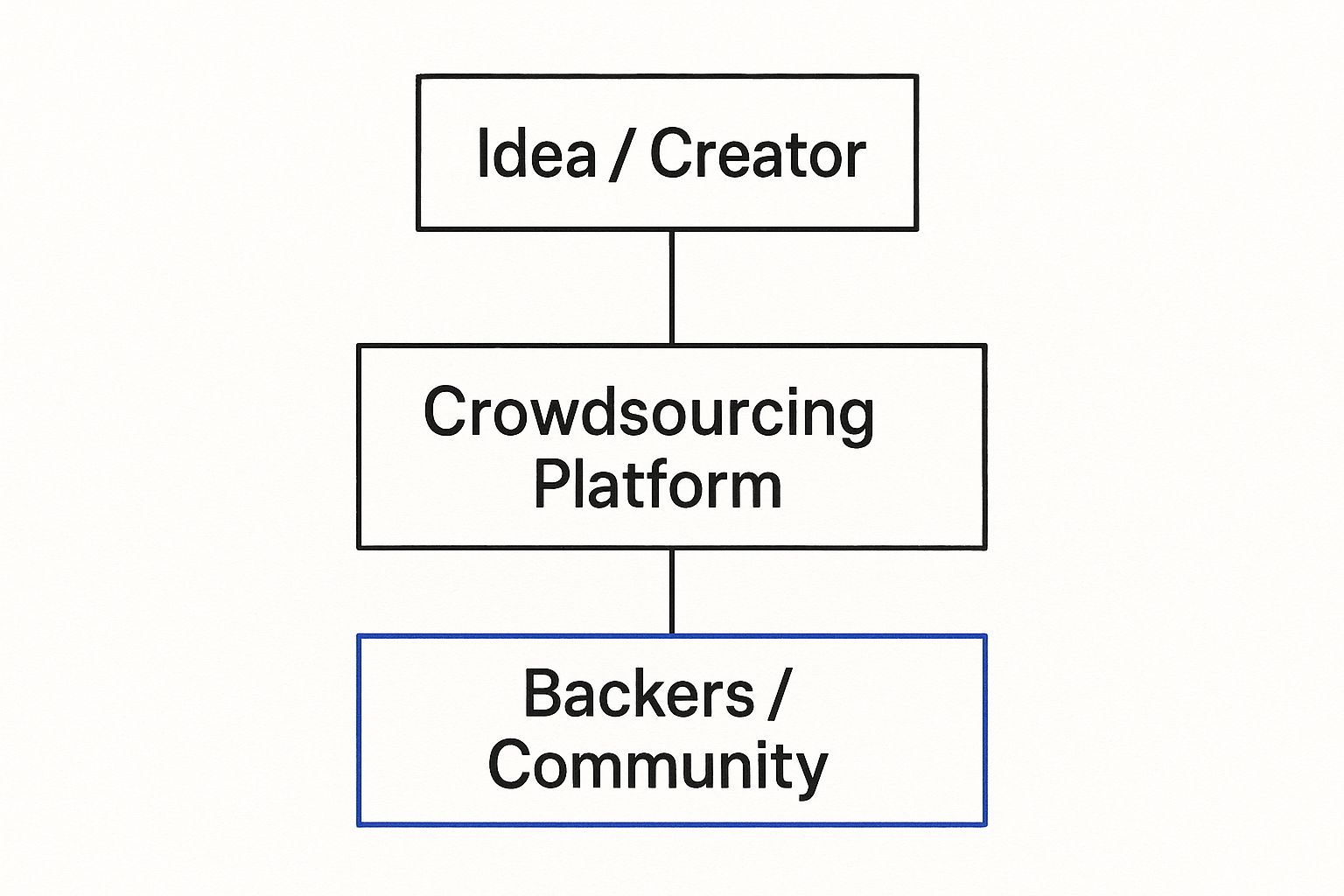
As you can see, the platform is the essential middleman, linking a creator’s vision with the collective power of their community. This dynamic relationship is what makes the whole system tick.
The real magic of crowd sourcing sites is their ability to prove an idea has legs before it even hits the market. By getting direct support from backers, creators don’t just raise money—they build a built-in community of loyal, early adopters who are invested in their success.
And it's a huge market. As of January 2025, the global crowdfunding market hit an estimated volume of $1.05 billion. A platform like Kickstarter alone has seen over 650,000 projects launched, which just goes to show how powerful this model has become.
Want to see this in action? Take a look at these powerful user-generated content examples. They're a fantastic showcase of how a community’s collective input can lead to some truly incredible results.
But the relationship with backers doesn't stop once the campaign succeeds. This is where pledge managers come into the picture. If a crowdfunding platform like Kickstarter is the Amazon where you launch your product, then a pledge manager like PledgeBox is the Shopify where you manage your customers.
Crucially, PledgeBox is free to send the backer survey and only charges 3% of upsell revenue if there's any. This makes it an incredibly effective tool for creators to manage rewards, collect shipping info, and handle fulfillment without a hitch.

Crowdfunding platforms come in many flavors. Choosing the right one is like picking the correct wrench for a niche bolt.
Each model brings its own audience, rewards, and expectations. Below, we’ll unpack the four major types so you can zero in on the perfect fit.
Reward-based campaigns feel a lot like pre-orders—backers pay now for the product you’re building later. This approach is most familiar thanks to platforms like Kickstarter and Indiegogo.
This model shines when you need to validate demand before mass producing a run. For more details, compare Kickstarter vs. Indiegogo.
When goodwill drives the campaign, donation-based crowdfunding takes center stage. Platforms such as GoFundMe empower causes without offering material rewards.
GoFundMe has gathered around $25 billion in donations, proof of how social generosity can move mountains.
Equity crowdfunding lets supporters become shareholders. Think of it as selling slices of your company in exchange for capital.
While this route can be powerful, it’s wise to explore traditional startup investor opportunities alongside equity campaigns.
Peer-to-peer lending channels collective funds as loans, complete with interest and repayment terms. It’s like replacing a bank lender with dozens—even hundreds—of individual investors.
Globally, crowdfunding has moved over $67 billion, with lending platforms alone accounting for $32.3 billion. For deeper insights, see crowdfunding statistics and their impact.
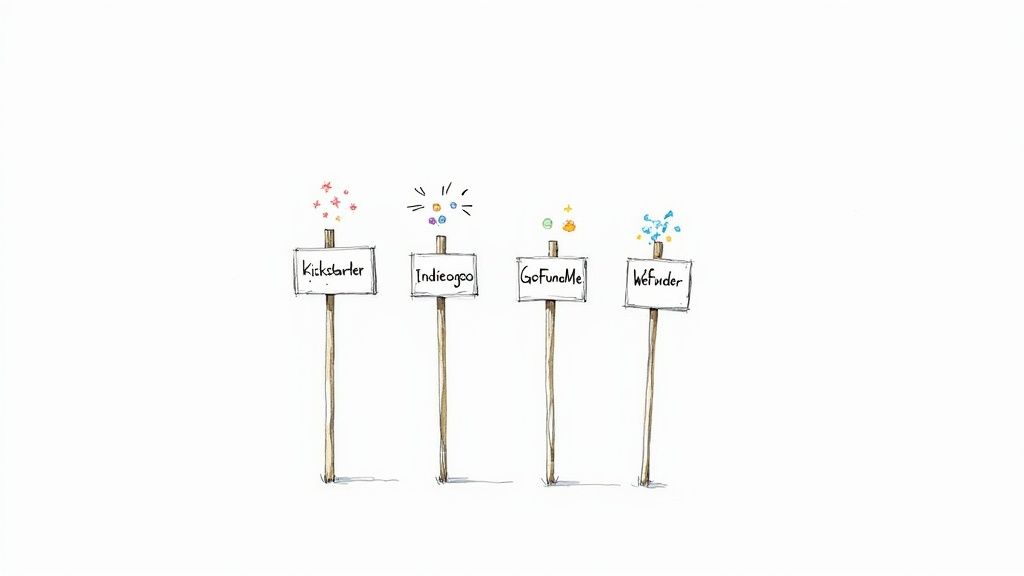
Diving into the world of crowd sourcing sites can feel like walking into a massive, bustling marketplace. Each platform has its own vibe, community, rules, and strengths. Finding the right home for your project is absolutely key to a successful launch.
Let's break down some of the biggest names in the game to help you figure out where your project truly belongs.
When you think of rewards-based crowdfunding, Kickstarter is probably the first name that pops into your head, and for good reason. Since it kicked off in 2009, its community has successfully funded over 284,000 projects, cementing its reputation as the spot for creative and innovative ideas.
It runs on a classic "all-or-nothing" model. This means you only get the money if you hit your funding goal by the deadline—a feature that creates a sense of urgency and gives backers the confidence that you'll have the cash to deliver.
Indiegogo offers a powerful alternative, especially for creators who need a bit more flexibility. Its standout feature is the choice between fixed (all-or-nothing) and flexible funding, where you keep whatever you raise, even if you fall short of your target. This makes it a safer bet for projects that can still move forward with partial funding.
On top of that, Indiegogo’s InDemand feature lets you keep raising funds even after your campaign officially ends, turning a one-time launch into an ongoing storefront.
The core difference really comes down to risk. Kickstarter’s model guarantees you have the full budget needed for production. Indiegogo's flexible option gives you capital to get started, slashing the risk of walking away empty-handed.
While Kickstarter and Indiegogo are all about commercial and creative projects, GoFundMe is the undisputed king of personal and charitable fundraising. It's become the go-to platform for people raising money for medical bills, community initiatives, and nonprofit causes.
GoFundMe’s model is built on straight-up donations, not rewards. Its magic lies in its simplicity and powerful social sharing tools, which make it incredibly easy for friends and family to chip in and support a cause. For personal campaigns, there's no platform fee—just the standard payment processing fees.
For startups looking to raise serious capital by selling shares, equity-based crowd sourcing sites like Wefunder are the answer. Here, backers aren't just pre-ordering a product; they're becoming investors with a small stake in your company.
This model is a perfect fit for high-growth businesses that can paint a compelling picture of future returns. It does involve more legal and financial legwork, but it opens the door to raising significant capital from a huge pool of investors.
No matter which platform you choose, the work doesn't stop when the campaign clock hits zero. The next critical step is managing all your backer information and getting those rewards out the door. This is where a pledge manager becomes your best friend.
Think of it this way: the Kickstarter pledge manager is like Amazon, a massive marketplace where you first launch your product. A tool like the PledgeBox pledge manager, on the other hand, is like Shopify—it gives you a personalized storefront to manage your customer relationships after the initial sale. Better yet, PledgeBox is free to send the backer survey and only charges 3% of upsell revenue if there's any, making it a risk-free way to streamline fulfillment and even boost your total funds.
https://www.youtube.com/embed/vVyyasJAN6Q
Picking from the sea of available crowd sourcing sites is one of the biggest calls you'll make for your project. This isn't just about going with the most famous name; it's about finding a home where the features, community, and rules actually fit what you're trying to build. Get this right, and you're set up for success. Get it wrong, and you could be fighting an uphill battle from day one.
The first, and arguably most important, fork in the road is the funding model. Platforms generally operate in one of two ways: All-or-Nothing or Flexible Funding. Each comes with its own set of pros and cons that you need to weigh against your project’s bottom line.
The All-or-Nothing model, made famous by Kickstarter, is exactly what it sounds like. You only get the money if you hit or beat your funding goal by the deadline. It's a high-stakes approach, but it creates a powerful sense of urgency that can rally backers to pledge and share your campaign. It also guarantees you'll have the capital you need to actually deliver on your promises.
The catch? If you miss your target by even a single dollar, you walk away with absolutely nothing.
On the flip side, the Flexible Funding model, used by platforms like Indiegogo, lets you keep every dollar you raise, whether you hit your goal or not. This is a much safer bet, especially for projects that can still move forward with partial funding. The risk here is that you might end up with just enough money to be in a tough spot—obligated to produce rewards but without the full budget you actually needed.
Once you've wrapped your head around the funding models, it's time to dig into the other details that can make or break a campaign. You’ll want to look closely at fee structures, any marketing support offered, and the kind of audience each platform attracts.
Here’s a quick comparison to help you decide which funding model might be best for your project.
Choosing the right fit is more important than ever. The global crowdfunding market is exploding, projected to jump from $17.72 billion to $20.34 billion with a compound annual growth rate of about 14.8%. With tech projects alone making up a 35% market share, picking the right platform is your ticket to tapping into this massive audience. You can explore more about these market trends to better position your project.
Finally, don't forget that the work isn't over when the campaign ends. Post-campaign management is just as critical as the launch. Think about the tools you'll need after the clock runs out. For instance, the native Kickstarter pledge manager is like launching on Amazon—a huge marketplace with built-in traffic. In contrast, the PledgeBox pledge manager is more like Shopify, giving you a dedicated system to manage your backer relationships and upsell products.
A huge plus is that PledgeBox is free to send the backer survey and only charges 3% of upsell revenue if there's any, making it a powerful, low-risk tool for getting your rewards out the door.
Hitting your funding goal on crowd sourcing sites is an incredible feeling. But it's not the finish line—it's the starting gun for a whole new race. This next phase is all about managing your backers and delivering on your promises, and frankly, it’s where many campaigns stumble. Getting this part right requires serious organization, clear communication, and a solid fulfillment plan.
Successfully navigating this stage means you need a specific set of tools for the job. While your crowdfunding platform got you funded, a pledge manager is what helps you manage the aftermath. Making this transition is absolutely critical for keeping the trust and goodwill you’ve worked so hard to build with your community.
To really get the difference, let’s use a simple analogy. Think of the native Kickstarter pledge manager as being like Amazon—it’s a massive marketplace, perfect for launching your product to a huge audience. It’s where people discover your idea and decide to buy in.
But once that sale is made, you need a different kind of tool to handle the customer relationship. This is where a dedicated pledge manager like PledgeBox comes into the picture. To continue the analogy, the PledgeBox pledge manager is like Shopify—it gives you a personalized, powerful backend to send surveys, process orders, and talk directly with your backers.
This specialized software helps you wrestle with the most complex parts of fulfillment, turning what could be a chaotic mess into a smooth, manageable workflow. For a more detailed breakdown, check out this super helpful after-the-crowdfunding-campaign checklist.
A good pledge manager does way more than just collect addresses. It acts as a central hub for everything that happens after your campaign ends, giving you the control you need to deliver rewards accurately and on time. This is a lifesaver, especially for projects with lots of reward tiers or product variations.
Here are a few of the key tasks these tools handle:
This upsell feature is one of the most powerful aspects of a pledge manager. It provides a final opportunity to boost revenue from an already engaged audience who believes in your project.
What makes this even more compelling for creators is the accessible pricing. For instance, PledgeBox is free to send the backer survey and only charges 3% of upsell revenue if there is any. This low-risk model means you can use a powerful fulfillment tool with no upfront cost, paying only when you make extra money. It's a smart way to guarantee a smooth delivery process while squeezing every last bit of profit out of your campaign.
Even with the best-laid plans, jumping into crowd sourcing sites for the first time can feel a little intimidating. There are always a few lingering questions. Let's tackle some of the most common ones creators ask to help you feel more confident before you hit that launch button.
This is one of the first questions on every creator's mind, and for good reason. A good rule of thumb is to budget for around 8-10% of your total funds raised to go toward platform and processing fees.
This cost is usually split into two parts. First, you have the platform fee. Sites like Kickstarter and Indiegogo typically charge about 5%, but only if your campaign is successful. Then, there’s the payment processing fee, which adds another 3-5% to cover the cost of each transaction. Keep in mind that equity and lending platforms often have totally different fee structures, so always double-check the terms of your chosen site.
Think of your crowdfunding platform as the place you sell the dream, and a pledge manager as the tool you use to deliver on that dream after the campaign ends. It’s a post-campaign system that helps you sort out all the critical backer information and fulfillment details.
To put it another way, the native Kickstarter pledge manager is a bit like Amazon—a massive marketplace to get your product out there. A dedicated tool like the PledgeBox pledge manager is more like Shopify; it gives you a focused system to manage your backer relationships, send out detailed surveys for shipping info, and let people pick options like sizes or colors.
A huge benefit of using a pledge manager is the ability to offer add-ons and upsells. This can give your final funding total a serious boost. For instance, PledgeBox is free for sending the main backer survey and only charges a 3% fee on money raised from these upsells, which makes it a smart, low-risk choice for any project with moving parts.
Time and time again, the two biggest hurdles are marketing and communication. You can't just build a great campaign page and hope people find it. You need a real plan to bring in traffic from social media, your email list, and PR.
The second challenge is keeping up with transparent, consistent communication. Your backers are your investors, and they want to hear from you regularly—especially if you hit a snag or a delay. Open communication builds trust, which is everything in crowdfunding. Silence, on the other hand, can sink your reputation fast. Lastly, getting your production and shipping costs right from day one is absolutely vital to avoid ending up in a financial hole.
Yes, absolutely! In fact, many breakout successes are second attempts. A failed campaign isn't just a failure; it's a massive source of free market research. It gives you a chance to see what didn’t connect. Was your goal too high? Were the rewards not quite right? Did your marketing fall flat?
Take what you've learned, tweak your project, and spend more time building an audience before you try again. Most platforms, including Kickstarter, are happy for creators to relaunch. A well-planned second go often shows a kind of grit and belief in the project that can really win over a community.
Ready to streamline your next campaign from pre-launch to fulfillment? PledgeBox provides an all-in-one toolkit designed for creators. Manage surveys, upsell add-ons, and handle shipping with ease. Get started with PledgeBox today!
PledgeBox
The All-in-One Toolkit to Launch, Manage & Scale Your Kickstarter / Indiegogo Campaign