 PledgeBox
How Do I Start a Kickstarter A Proven Guide
Wondering how do I start a Kickstarter? This guide provides a clear roadmap from idea validation and community building to funding and fulfillment.
Wondering how do I start a Kickstarter? This guide provides a clear roadmap from idea validation and community building to funding and fulfillment.
A successful Kickstarter campaign really comes down to nailing four things upfront: validating your idea, figuring out who your backers are, setting a smart funding goal, and creating a realistic timeline. If you can get these fundamentals right, you’ll build the kind of momentum you need for a killer launch.
Kicking off a Kickstarter project can feel like a massive undertaking, but a solid plan breaks it down into manageable chunks. This isn't just about having a cool idea; it's about proving people actually want it, finding those people, and building a strategy that can handle the chaos of a live campaign. A big launch day doesn't happen by accident—it’s always the result of serious prep work.
Before you even dream of building your campaign page, you need to validate your concept. Is there a real-world demand for what you’re making? A great place to start is by looking at similar projects that have either crushed it or crashed and burned on the platform. Dive into their funding levels, backer counts, and reward tiers. This homework is priceless for understanding the lay of the land and dodging rookie mistakes. For a deeper dive, check out this excellent step-by-step guide to bring your project to life on Kickstarter.
Once you’re sure your idea has legs, you have to know exactly who you're talking to. A huge part of any Kickstarter plan is defining your target market so you're not just shouting into the void. I always recommend creating a detailed "backer persona" to help you tell a story that truly connects.
Armed with this info, you can shape every single piece of your campaign—from the video script to the pledge levels—to speak directly to the people most likely to hit that "Back this project" button. This turns a generic pitch into an invitation to join a movement, not just buy a thing.
Your funding goal is one of the most stressful but critical decisions you'll make. Aim too high, and you risk the campaign failing. Go too low, and you might not have enough cash to actually make and ship your rewards. Your goal should be the bare minimum you need to bring your project to life. This includes manufacturing, shipping, Kickstarter's 5% fee, and payment processing fees (3-5%).
Don’t forget, Kickstarter is all-or-nothing. If you miss your goal by even a dollar, you get nothing. It's almost always better to set a modest, achievable goal and smash it with stretch goals than to aim for the moon and come up empty-handed.
This simple flowchart breaks down the core planning process, from refining that initial spark of an idea to defining your audience and setting that all-important financial target.
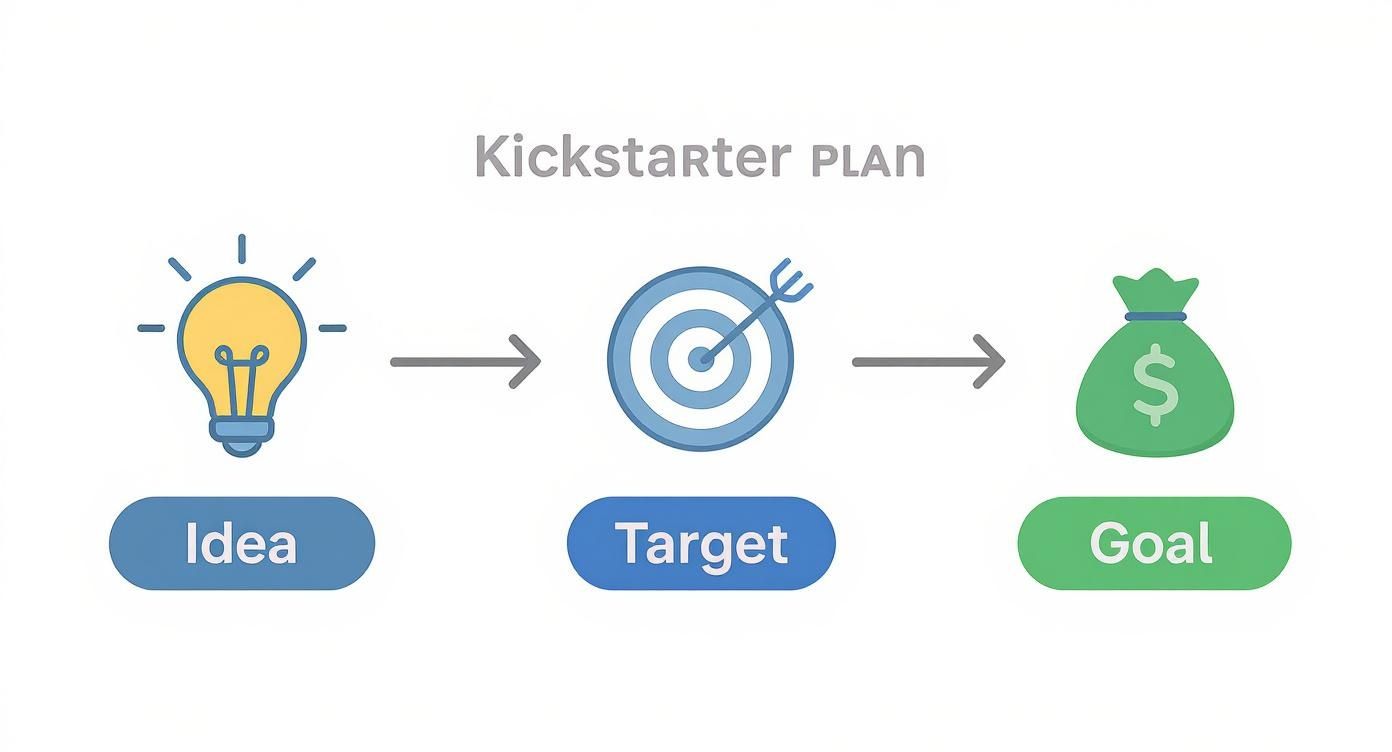
As you can see, a successful campaign starts long before you press "launch." It’s built on a strategic foundation of market research and crystal-clear objectives.
A killer Kickstarter campaign never just appears out of thin air. The creators who really crush it know the real work starts months before launch day. It all comes down to one thing: building a dedicated community that’s ready to back your project the second it goes live.
Launching to crickets is the fastest way to fail. But launching to an enthusiastic, pre-built audience? That’s how you get the velocity you need to blow past your funding goal. This whole pre-launch phase is about turning casual interest into genuine support. Your main objective is to gather a core group of followers who aren't just aware of your project, but are emotionally invested in seeing it succeed. This is where a high-converting pre-launch landing page becomes your secret weapon.
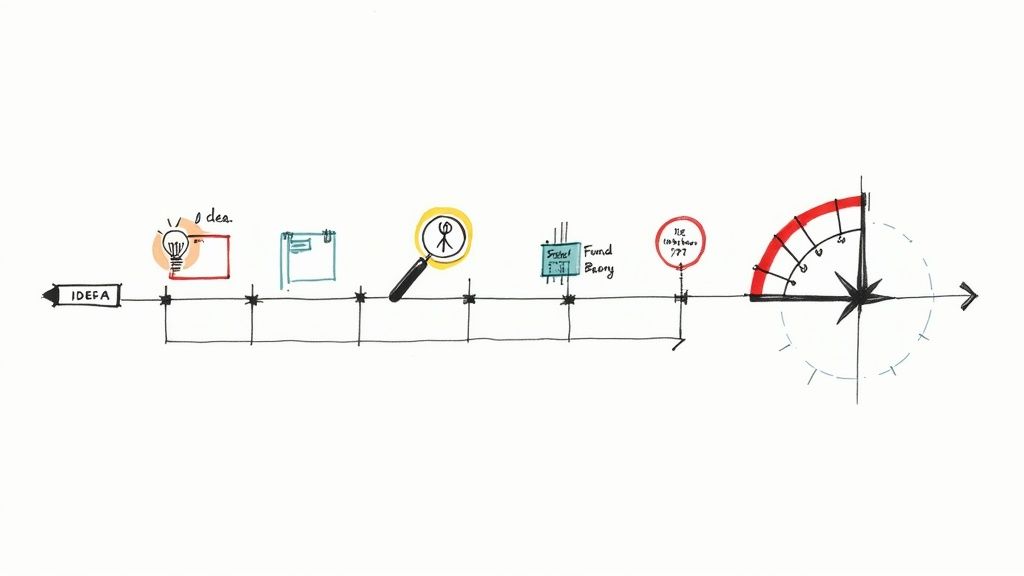
Think of your pre-launch page as the front door to your campaign. It has one job and one job only: to capture email addresses from people who are genuinely fired up about what you're creating.
Tools like PledgeBox make setting these pages up incredibly simple, letting you start building your most valuable asset—your email list—from day one.
Keep the page simple but powerful. It just needs a few key things:
This isn’t just about collecting contacts. Every single sign-up is a vote of confidence, telling you that you're on the right track.
Once you have their email, the real work begins. You need to keep this budding community engaged and excited so they're primed and ready for launch. That means sharing your journey with total transparency and passion, making them feel like true insiders. For a deeper dive, check out these seven actions to build your community before your Kickstarter campaign.
Don't just send out boring announcements. Share behind-the-scenes content, ask for feedback on designs, and tell the story of why you’re so obsessed with this project. Get active in niche forums, relevant subreddits, and social media groups where your ideal backers are already hanging out. This hands-on approach builds real trust and turns subscribers into your biggest advocates.
You absolutely cannot overstate the power of this early community. When your campaign launches, these are the people who will provide that critical first-day funding. This creates the social proof and momentum that pulls in organic backers from across the Kickstarter platform.
That initial surge is what trips Kickstarter's discovery algorithms, getting your project in front of a much, much wider audience. Without it, even the most brilliant ideas can stall out.
Let's talk data. Building a community isn't just a nice idea; it's one of the most effective strategies out there. Top-tier campaigns often kick off with an email list of at least 1,000 subscribers. Having a list that size is correlated with a fivefold increase in the likelihood of hitting your funding goal.
Why? Because projects that fail to get early pledges almost never succeed. In fact, if a project doesn't reach 20% of its goal in the first few days, it’s highly unlikely to recover.
This all leads to a crucial point after your campaign funds: managing all those backers. This is where pledge managers come into play. You can think of the Kickstarter pledge manager like Amazon—it's basic and standardized. A dedicated tool like PledgeBox, on the other hand, is like Shopify; it gives you the power to completely customize the backer experience.
And here’s the best part: PledgeBox is free to send the backer survey and only charges 3% of any upsell revenue if there is any. This setup lets you grow your funds even after the campaign clock has run out.
Think of your Kickstarter page as your project's home base. It’s your digital storefront, your investor pitch, and your story, all rolled into one powerful package. This is where your pre-launch community will land, and it’s how organic backers will discover you.
Getting this page right is often the difference between a campaign that fizzles out and one that absolutely crushes its goal. It's not just about listing features; it’s about weaving a narrative that pulls people in and makes them feel like they need to be part of your journey.
The first thing anyone sees is your project title and campaign video. These are your hooks, and you’ve got seconds to grab their attention. Your title needs to be descriptive but catchy, clearly explaining what the project is while sparking enough curiosity to get that click.
Let's be clear: your video is non-negotiable. Campaigns with a video are wildly more successful because it’s your one chance to speak directly to your audience. This is where you get to show off your passion, demonstrate your prototype in action, and tell the story behind why you created this thing in the first place.
You don’t need a Hollywood budget, but quality is key.
This video is your number one sales tool. It sets the tone for the entire campaign and is often the final nudge a potential backer needs.
Once the video gets them excited, the rest of your page has to seal the deal. You need to structure the information logically, using a mix of great visuals and compelling text to keep readers scrolling.
A giant wall of text is an instant "nope" for most visitors. Instead, guide them through a story. For more tactical advice on page layout, check out our guide on how to design a high-conversion Kickstarter landing page.
Use high-quality photos and dynamic GIFs to break up the text and show your product from every conceivable angle. Crisp, scannable paragraphs and clear headings make it easy for visitors to find the info they're looking for. Be completely transparent about your team, your timeline, and your budget—this builds incredible trust and shows backers you have a solid plan for their money.
The category you choose also matters more than you might think. The most popular and well-funded categories on Kickstarter are games, design, technology, and film. Games, for instance, have pulled in roughly $2.63 billion in pledges, making it the top-funded category by a long shot. Choosing a category with a built-in, passionate audience can give you a serious leg up.
Your reward tiers are where the magic happens. This is where you turn a curious visitor into a paying backer. They need to be crystal clear, compelling, and offer genuine value at every price point.
A classic rookie mistake is offering way too many options. This leads to decision paralysis, where a potential backer gets overwhelmed and just clicks away. Keep your reward tiers focused—somewhere between 5 and 7 distinct levels is the sweet spot.
Pricing them strategically is just as important. Use these proven tactics to create urgency and incentivize bigger pledges:
And remember, the work isn't over once you hit your funding goal. Stretch goals—extra features or bonus rewards unlocked at higher funding milestones—are fantastic for keeping the energy high. They give your existing backers a reason to share the campaign and new backers a reason to jump in before it's too late. This is how a successful campaign becomes a true blockbuster.
The moment your campaign goes live, the real work begins. All that pre-launch effort was about creating a massive starting push, but a 30-day campaign is a marathon. It demands constant attention, savvy marketing, and an open line of communication with your backers. The strategies you use during this critical window will make the difference between cruising past your funding goal and fizzling out halfway through.

Your day-one strategy is all about activating the community you've spent months building. Your very first move should be sending a launch announcement to your email list. These are your true believers, ready to jump in and create that initial surge of pledges that provides social proof and gets Kickstarter's algorithms to notice you.
This initial momentum isn't just a nice-to-have; it's statistically vital. Understanding the odds can be a powerful motivator. The overall success rate for Kickstarter projects sits at 41.98%, which means just over four out of every ten projects actually hit their goal. The other 58.02% fail to fund.
Here’s the kicker: most unsuccessful projects never even get to 20% of their funding goal. But projects that do pass that crucial 20% mark are overwhelmingly likely to succeed. You can dive deeper into the stats on Statista to see how important that initial funding velocity is.
To help you focus your efforts, we've put together a table summarizing the elements that have the biggest impact on a campaign's outcome.
This table breaks down the critical elements and their impact on your campaign's likelihood of reaching its funding goal.
Focusing on these areas, especially a strong pre-launch and a compelling story, will dramatically increase your chances of joining the 41.98% of successful projects.
Pretty much every campaign hits it: the dreaded mid-campaign slump. After the initial launch excitement dies down, pledges slow to a crawl. This is totally normal, but it's where a lot of creators start to panic. The secret is to have a plan ready to go to re-energize your audience and pull in new backers.
This is the perfect time to switch on your targeted social media ads, focusing on lookalike audiences that mirror your existing backers' demographics. It's also when you should be sending those personalized outreach emails to the press contacts, bloggers, and influencers you researched during your pre-launch phase.
Constant, transparent communication is your most powerful tool during this lull. Don't go silent. Use project updates to share behind-the-scenes progress, reveal new artwork, or conduct a Q&A with your backers. This keeps your community engaged and shows potential new backers that you're an active and trustworthy creator.
Think of your comments section as the living, breathing heart of your campaign. It's where potential backers go to ask questions and see how responsive you are, and where current backers share their excitement. Managing it well isn't optional.
Here are a few best practices that have always served me well:
This kind of active engagement builds a powerful sense of community and trust that can elevate a good campaign into a truly great one.
Stretch goals are so much more than just funding milestones. They're story beats that can reignite excitement at any point in your campaign. Instead of just listing them all at the start, try revealing them one by one as you get close to hitting each new target. This creates a feeling of continuous discovery and gives you a fantastic reason to post an update.
A well-designed stretch goal should add real value for every backer, not just those at the highest tiers. Think about component upgrades, new digital content for everyone, or an extra color option. Each unlocked goal is a collective win for your community to celebrate, giving them a powerful reason to share the campaign and help you push toward a blowout success.
You did it. The campaign clock hit zero, the digital confetti settled, and your project is officially funded. Take a moment to celebrate—this is a huge accomplishment. But once the excitement fades, a new and equally critical phase begins: post-campaign management and fulfillment.
Honestly, how you handle this stage will define your reputation long after the last package is shipped. It’s what separates one-hit wonders from creators who build a loyal following. This is where you transition from being a project visionary to a manager of logistics, data, and customer service for potentially thousands of people. The key to not getting overwhelmed is having the right tools in your corner.
Once your campaign ends, you need to collect critical info from every single backer, starting with their shipping address. You also need a way to manage pledge adjustments, accurately charge for shipping, and let backers grab any last-minute add-ons they decided they wanted. This is exactly what a dedicated pledge manager is for.
Sure, Kickstarter has its own survey tool, but it's pretty bare-bones. A specialized pledge manager gives you way more control and opens up opportunities to improve the backer experience—and even increase your total funding after the campaign is over. Think of it as the operational headquarters for your entire fulfillment phase.
Here's a helpful analogy: Kickstarter’s pledge manager is like Amazon. It’s functional and gets the job done in a very standardized way. A dedicated pledge manager like PledgeBox is like Shopify. It puts you in the driver’s seat with a customizable suite of tools to control the experience, upsell add-ons, and manage backer relationships like a pro.
This is a crucial distinction for anyone serious about building a real brand. You get the power to create a seamless, branded experience that feels like a natural part of your campaign, not just a generic form.
One of the best features of a tool like PledgeBox is the ability to offer upsells. When you send out your backer survey to gather shipping details, you can also present backers with a curated shop of add-on items. It's a golden opportunity.
You could offer things you couldn't quite fit into the original reward tiers, like:
This isn't just about squeezing out a few extra dollars. It’s about giving your biggest fans one last chance to get more of what they love. You’d be amazed how many people jump at the chance to add just one more thing to their order. This extra revenue can be a lifesaver, helping to cover unexpected production hiccups or beef up your shipping budget.
And here’s the best part: PledgeBox is free to send the backer survey and only charges 3% of any upsell revenue if there's any. This risk-free model means you get a powerful management tool with no upfront cost, and you only pay a tiny fee on the extra money you make. It’s a no-brainer for creators at any level.
To really see the difference, it helps to put the two side-by-side. Relying on Kickstarter's default tools is one thing, but adopting a specialized pledge manager is a true upgrade for your operations.
As the table shows, a tool like PledgeBox takes post-campaign management from a simple data collection chore and turns it into a strategic part of your business. You get more control, give your backers a better experience, and open up a new stream of revenue right when you need it most. This is how you stop just running a Kickstarter and start building a brand.
Diving into your first Kickstarter campaign can feel a little overwhelming. You've done the planning, built your audience, and polished your page, but there are always those lingering questions. Let’s tackle some of the most common ones that new creators have when figuring out how to start a Kickstarter.
This is the million-dollar question, isn't it? While you see headlines about campaigns raising astronomical sums, the reality for most first-time creators is much more grounded. A successful debut project typically lands somewhere between $5,000 and $50,000.
Your true funding potential isn't just luck; it boils down to the appeal of your product, how big and excited your pre-launch community is, what you're spending on marketing, and the overall quality of your campaign page. The best way to get a realistic number is to do some homework. Find successful projects in your niche and see what they pulled in. That research gives you a solid benchmark to aim for.
I've seen so many new creators hit the same roadblocks. If you can steer clear of these, you're already ahead of the game.
Think of your backers as partners, not just customers. Transparency and solid planning are your best defenses against these classic blunders.
Yes. 100% yes. In fact, Kickstarter’s rules require a working prototype for most physical product categories, and for good reason. It's not just about following rules; it's about earning trust.
Your prototype is your single most important marketing asset. It's what you'll use for all your killer photos and videos. It proves to backers that your idea is real, that it works, and that you have a clear path to production. That credibility is priceless.
For most projects, 30 days is the magic number. It strikes the perfect balance—long enough to build momentum and get the word out, but short enough to create a sense of urgency that encourages people to pledge.
Shorter campaigns (around 15-20 days) can work, but only if you have a massive, hyped-up audience ready to jump on day one. On the flip side, campaigns that drag on for more than 45 days tend to fizzle out and have lower success rates. Trust the process and stick with 30 days.
Once the campaign wraps, the next challenge is managing all your backers. This is where a great pledge manager comes in. Kickstarter's pledge manager is like Amazon, functional but basic. A dedicated tool like PledgeBox, on the other hand, is like Shopify, giving you way more control. The best part? PledgeBox is free to send the backer survey and only charges 3% of any upsell revenue if there is any, giving you a powerful way to boost your funds after the campaign ends.
Ready to streamline your post-campaign process and boost your funding with powerful upsell tools? Get started with PledgeBox and see how a dedicated pledge manager can transform your fulfillment experience. Discover more at https://www.pledgebox.com.
PledgeBox
The All-in-One Toolkit to Launch, Manage & Scale Your Kickstarter / Indiegogo Campaign