 PledgeBox
Kickstarter for Businesses A Complete Launch Guide
Explore our complete guide on Kickstarter for businesses. Learn how to launch a winning campaign, validate your idea, and build a community from the ground up.
Explore our complete guide on Kickstarter for businesses. Learn how to launch a winning campaign, validate your idea, and build a community from the ground up.
When you think of using Kickstarter for businesses, you might just see a way to raise money. But that's only scratching the surface. It's a seriously powerful tool for checking if your product idea is a winner, building a die-hard fan base, and getting pre-orders locked in before you even think about starting production.
Think of it as the ultimate market test where people vote with their wallets.

Let's clear something up: Kickstarter isn't some digital donation jar for passion projects anymore. For savvy businesses today, it's a launchpad that completely flips the script on how products are developed. It’s less like a stuffy boardroom pitch to investors and more like the world's best pre-order platform. You get to skip the part where you sink a bunch of cash into an unproven idea and instead, show your vision directly to the only people who truly matter: your future customers.
This gives you immediate, real-world feedback. If strangers are willing to back your project with their own money, you've got solid proof that people actually want what you're selling. That kind of validation is priceless. It's the green light to go into manufacturing with a whole lot less financial risk. A successful campaign isn't just about the money raised—it’s about creating a tribe of early believers who are invested, both financially and emotionally, in your success from day one.
The core of the Kickstarter platform is its "All-or-Nothing" funding model. This rule is simple: you only get the money if you hit your funding goal. If you fall short, even by a dollar, no money changes hands. It might sound a bit scary, but it's actually a huge safety net for creators.
This model saves you from the nightmare of being underfunded and unable to deliver on your promises. It protects your brand’s reputation and, just as importantly, your backers' trust. It forces you to be smart and meticulous with your budget, making sure you have exactly what you need to go from prototype to production.
Getting this right is a big deal. Since it started in 2009, Kickstarter has helped creators raise over $8.5 billion, but the overall success rate for campaigns is just 41.98%. This number really drives home how important it is to have a solid plan and a product people genuinely want. You can dig into more Kickstarter success stats on Statista.com.
A Kickstarter campaign gives you so much more than just cash. The whole process is a marketing machine that builds excitement and gets people talking. Here are a few of the key perks:
At the end of the day, using Kickstarter for your business is a strategic move to de-risk your launch, tell a compelling brand story, and grow a community that’ll stick with you long after the campaign clock runs out. You can learn more by taking a quick look at everything Kickstarter has to offer.
For decades, the path to getting a business off the ground was pretty straightforward: you either convinced a bank to give you a loan or you pitched your heart out to venture capitalists. While those options are still on the table, a growing wave of savvy entrepreneurs is ditching the old playbook and launching on Kickstarter instead. This isn't just about finding another way to get cash—it's a deliberate strategy to build a stronger, more resilient business from the very beginning.
When you go the traditional route, you're either taking on debt or giving up a piece of your company. With Kickstarter, you keep 100% of your business. That's a huge deal. Your backers aren’t investors demanding a return; they're your first customers, pre-ordering a product they're excited about. This means you're in complete control, answering to the community that believes in you, not to a boardroom.
Securing a loan or VC money happens behind closed doors. A Kickstarter campaign? It's a full-blown public launch event. The entire process, from the pre-launch buzz to the final nail-biting countdown, creates organic hype, social proof, and media attention that would cost a fortune to buy.
More importantly, it gives you instant market validation. Forget spending months on focus groups and market research. A successful campaign is undeniable proof that people are willing to open their wallets for your idea. The feedback you get is priceless, too. Backers will often chime in with brilliant suggestions, helping you tweak features and perfect your product before you ever place a massive manufacturing order.
Let's break down the core differences.
The choice between crowdfunding and traditional funding isn't just about where the money comes from; it's about how you want to build and grow your business. This table highlights the key strategic differences.
FactorKickstarter for BusinessesTraditional Funding (VC/Loans)EquityRetain 100% ownership of your company.Give up a significant stake to investors or board members.ValidationDirect proof of market demand from real customers.Based on forecasts, market analysis, and investor belief.CommunityBuilds a loyal customer base and brand advocates from day one.Relationships are primarily with lenders or investors.MarketingThe campaign itself is a powerful, organic marketing engine.Requires a separate, often expensive, marketing budget.RiskLower financial risk; production is based on actual pre-orders.High risk; production based on projections, debt is incurred.ControlFull creative and operational control over your vision.Subject to investor influence and board oversight.
As you can see, Kickstarter offers a model built on community engagement and real-world proof, which can be a much stronger foundation for a new venture.
The infographic below offers another way to visualize these strategic advantages.
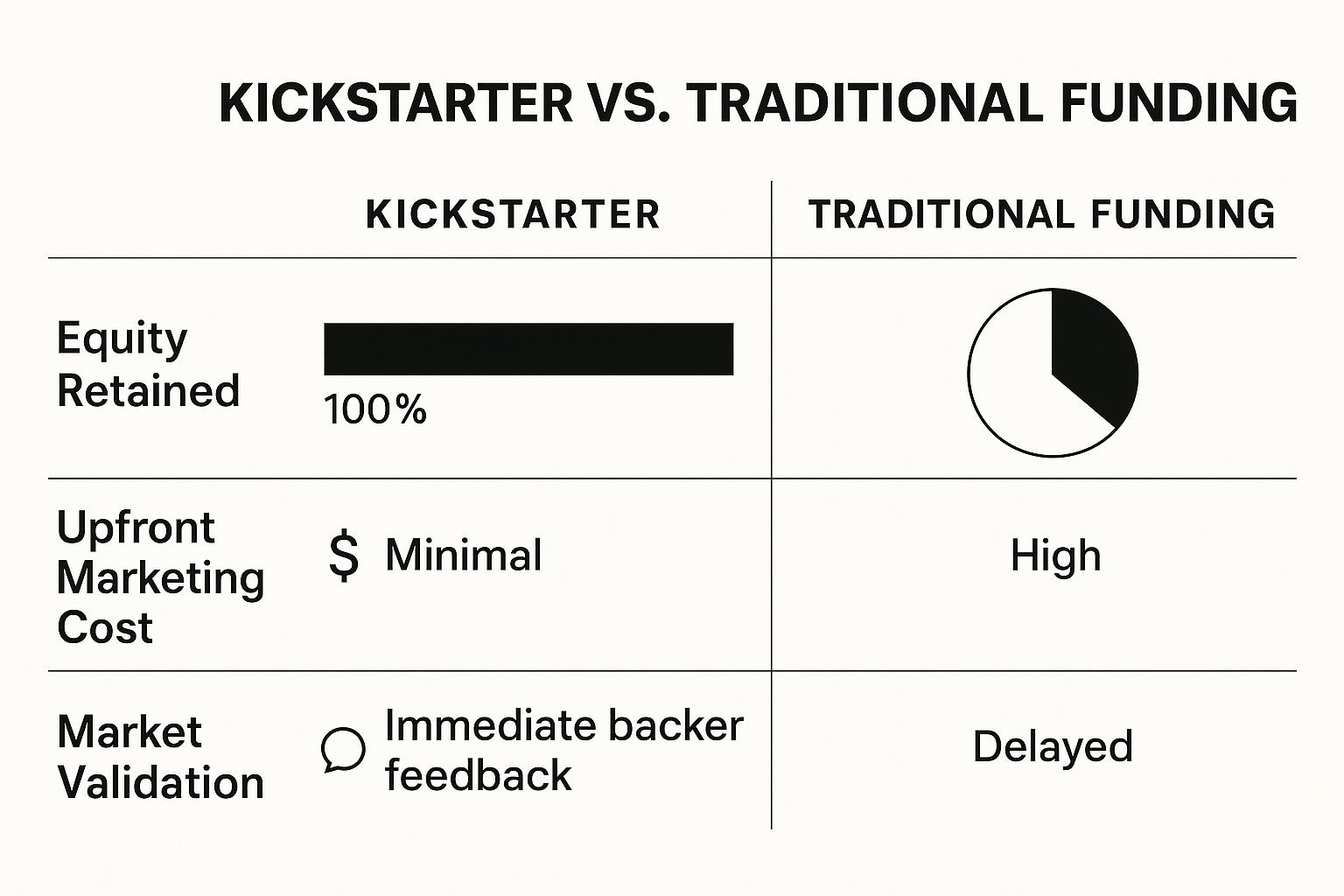
As it shows, crowdfunding gives you a clear edge in keeping your equity, minimizing upfront costs, and getting that crucial proof that your idea has legs.
One of the scariest parts of launching a new product is guessing how many to make. Order too few, and you've got angry customers and lost sales. Order too many, and you're stuck with a warehouse full of inventory that's draining your cash. Kickstarter elegantly solves this problem. The number of backers tells you exactly how many units to produce for your first run, slashing financial risk.
This is where the platform's ecosystem really shines. Think of the Kickstarter pledge manager as the Amazon of crowdfunding—it’s a massive marketplace where you can find and win over your first customers. But once the 30-day frenzy is over, you need a way to manage all those new relationships. That’s where a pledge manager is essential.
If the Kickstarter pledge manager is like Amazon, a pledge manager like PledgeBox is like Shopify. It’s your own dedicated storefront for managing backer relationships, collecting fulfillment details, and even driving more revenue after the campaign ends.
PledgeBox was built for this. It’s completely free to send your backer surveys to get shipping addresses and finalize orders. The platform only charges a 3% fee on upsells if you decide to offer add-ons, giving you a powerful, no-risk way to boost your total funding. This approach is quite different from Kickstarter's own survey tool, which works but offers a different structure. If you're weighing your options, this detailed guide on Kickstarter vs. Indiegogo and their toolsets can help you decide.
The numbers don't lie. In 2024, the North American crowdfunding market pulled in around $660.6 million in revenue and is only expected to keep climbing. This isn't just a fad; for countless modern businesses, Kickstarter is simply the smarter way to launch.
Here's one of the hardest truths you'll learn about using Kickstarter for businesses: the most successful campaigns are won long before they ever go live. The old "if you build it, they will come" idea is a dangerous myth in crowdfunding. Instead, you need to build your audience first so they are ready and waiting the second you hit "launch."
This pre-launch phase is all about gathering a core group of supporters who are genuinely excited about what you're making. You're not just looking for customers; you're creating a tribe of "Day One Backers" who are primed to pledge. That initial surge of support is everything—it creates the social proof and momentum needed to get noticed by the rest of the Kickstarter community.
Before you launch, your two most powerful assets are an engaged email list and a buzzing social media following. These aren't just vanity metrics; they're a direct line to your biggest fans, allowing you to build trust and anticipation one step at a time.
Start with a simple landing page that teases your project and has a crystal-clear call-to-action to sign up for email updates. Then, drive traffic there from social media, forums, and anywhere else your people hang out online. This email list will become your secret weapon for announcing your launch date and driving that critical day-one traffic.
Many creators start by building communities on social media, and learning to manage and grow those groups is a powerful skill. If you want to go deeper, there are fantastic resources on transforming a Facebook group into a profitable membership business.
Your pre-launch content needs to do more than just announce a product—it needs to tell a story. People don't just back products; they back people and their journeys. This is your chance to turn your entrepreneurial path into a narrative that others want to join.
Here are a few ways to build that connection and anticipation:
The power of this early community is massive. By January 2025, over 23.8 million people had backed projects on Kickstarter, and more than 8 million of them were repeat backers. That percentage of repeat backers keeps climbing, which tells us there's a loyal, trusting audience actively looking for great projects to get behind.
Think of Kickstarter as a giant marketplace, like Amazon, where millions of eager shoppers (backers) are hunting for the next big thing. Your pre-launch community building is what gets your "product" seen in that crowded space. But once you've made those initial "sales," you need a way to manage those relationships.
This is where a pledge manager becomes non-negotiable. If the Kickstarter pledge manager is like Amazon where you find your customers, a tool like PledgeBox is like your personal Shopify store. It's the platform you use after the campaign to manage backers, collect shipping info, and even offer more products through upsells.
PledgeBox makes this transition painless because it’s free to send the backer survey to collect all the fulfillment details you need. It only takes a 3% fee on upsell revenue if you successfully sell add-ons, making it a no-risk way to maximize your funds after the campaign clock stops. For more tips, check out these 7 actions to build your community before your Kickstarter campaign.

Think of your Kickstarter page as your digital storefront, your investor pitch, and your brand's origin story all rolled into one. When a potential backer lands there, you've got just a few precious seconds to grab their attention, earn their trust, and convince them to come along for the ride. A page that actually converts isn't about flashy tricks; it’s about crystal-clear storytelling that turns a casual browser into a committed supporter.
It all starts with a killer project video. This isn't just a product demo—it's your chance to connect with people on a human level. Show them your passion, explain why this project needs to exist, and make it obvious how your product solves a real-world problem. Keep it snappy (under three minutes is the sweet spot) and wrap up with a direct call to action asking people to back your campaign.
Your campaign page should read like a story, guiding visitors from initial curiosity to the final "I'm in!" moment. The layout needs to be intuitive and scannable, breaking down all the details into easy-to-digest chunks. High-quality photos and lifestyle shots are non-negotiable; they’re what help backers picture your product in their own lives.
The words you use are just as important. To get people to open their wallets, your copy needs to be compelling. You might want to brush up on some powerful persuasive writing techniques to really make your message stick. Always focus on the benefits, not just the features. Don't just list technical specs; explain how those specs make someone's life easier or better.
A great page almost always includes these core elements:
Your reward tiers are the engine that drives your entire campaign. If they're confusing, you'll lose backers and kill your momentum. But if they're designed well, they can dramatically increase your average pledge. The goal is to create a clear "value ladder" that tempts people to pledge just a little bit more.
Think strategically about pricing and value. Early-bird specials are a proven way to generate that critical day-one funding surge. These limited-quantity rewards create a sense of urgency and reward your most eager supporters for pledging immediately.
Beyond early-bird deals, think about creating smart bundles. Combine your main product with exclusive add-ons or accessories to create high-value packages that feel like a steal. You want backers to look at a bundle and think, "Wow, I'm getting an incredible deal here." Limiting the number of certain tiers also boosts their perceived value and pushes people to make a decision faster.
At the end of the day, a successful Kickstarter for businesses is built on trust. Be completely transparent about your budget, your timeline, and any potential roadblocks you see. People aren't just buying a product; they're investing in you and your vision. Give them a clear, honest, and exciting reason to believe, and they'll have no problem hitting that "Back this project" button.
That feeling when the campaign clock hits zero and you see you’ve blown past your funding goal? It’s pure magic. It’s a massive win and proof that your idea has real potential. But once the confetti settles, a new reality kicks in. This is where the real work starts—managing expectations and delivering on your promises.
The post-campaign phase is every bit as critical as the launch. Nailing it is how you turn excited backers into loyal customers for life. To do that, you need to shift your mindset and bring in a new set of tools. Your campaign page was the pitch; now you need a system for logistics. This is where a pledge manager becomes your business's new best friend.
Let’s use an analogy to really get this. Think of using Kickstarter for businesses like listing a product on Amazon. It’s a huge, bustling marketplace full of millions of potential customers (your backers) who are actively looking for the next cool thing to support. It’s the perfect place to get that initial groundswell of support.
But once the campaign ends, you need to move those new customers out of the crowded marketplace and into your own space. This is where a pledge manager like PledgeBox comes in. If the Kickstarter pledge manager is like Amazon, PledgeBox is like your personal Shopify store, giving you a dedicated, branded hub to handle everything that comes next.
Making this switch from a public marketplace to your own managed storefront is a critical step. It’s how you’ll collect all the essential information, figure out complicated shipping, and build a direct, lasting relationship with the community that just funded your dream.
So, your campaign is over. You’ve got a list of backer names and how much they pledged. But you're missing the most important detail: where to send their stuff. You also need a way for them to confirm their orders, pick options like colors or sizes, and pay for shipping—which can get messy with backers all over the world.
This is exactly what a pledge manager is built for. It's a specialized tool that sends a post-campaign survey to all your backers. Through this survey, you can:
Trying to juggle all of this with spreadsheets and a tangled web of emails is a recipe for disaster. It’s a massive time sink, riddled with human error, and frankly, it creates a clunky and unprofessional experience for your backers. A proper tool automates this entire workflow, saving you headaches and preventing expensive mistakes.
Here's one of the biggest perks of using a powerful pledge manager: you can actually keep raising money after the campaign is officially over. This happens through upselling. While backers are in the survey filling out their info, you can offer them exclusive add-ons, handy accessories, or even other products that go well with their original pledge.
This is where PledgeBox really shines. It’s built on a creator-friendly model designed to minimize your risk while maximizing your opportunity. In fact, PledgeBox is free to send the backer survey and collect all the fulfillment information you need. There are no setup fees and no per-backer charges to get things rolling.
The platform only makes money when you do. PledgeBox charges a 3% fee, but only on the upsell revenue you generate from any add-ons or upgrades your backers decide to buy. It’s a performance-based model, which means you get a powerful, risk-free tool to boost your total funding. That extra cash can be a game-changer, helping you cover unexpected production costs, invest in marketing, or just fatten up your profit margin.
Even with a solid plan, taking the plunge into crowdfunding can feel like a huge leap of faith. It's totally normal to have a few nagging questions before you hit that launch button. Let's clear up some of the most common ones so you can move forward with confidence.
Getting a handle on the true cost of a campaign is absolutely critical. It’s not just about what Kickstarter takes; you have to budget for the entire journey, from your first prototype all the way to a backer’s doorstep.
First, the platform fees. Kickstarter itself charges a 5% platform fee on successfully funded projects. On top of that, their payment processor, Stripe, tacks on a fee of roughly 3-5% per transaction. So, right out of the gate, you should plan on 8-10% of your total funds raised going to platform and processing costs.
But that’s just the tip of the iceberg. Here’s what else you need to budget for:
This is the big fear for a lot of creators, but it’s really not the end of the world. Kickstarter runs on an "All-or-Nothing" model. If you don't hit your funding goal by the deadline, no money changes hands. Backers are never charged, and you don’t get a single dollar.
While it can sting, a failed campaign is actually a goldmine of market feedback. It’s a loud and clear signal that something about your approach—whether it was the product itself, the price, the messaging, or your funding goal—just wasn't clicking with people.
Think of it not as a failure, but as a free market research study. Countless successful companies stumbled on their first try, used the feedback to regroup and refine their strategy, and came back to launch a wildly successful campaign.
Absolutely! In fact, you should be planning on it. The post-campaign phase is a massive opportunity to boost your revenue and strengthen your relationship with your new community. This is where a dedicated pledge manager becomes your best friend.
Once your Kickstarter ends, you’re no longer just on a public platform; you're now managing your own private storefront for the people who just funded your dream. A tool like PledgeBox is built specifically for this crucial next step.
Here's how it works: PledgeBox is free to send the backer survey, which is how you collect shipping addresses and confirm everyone's reward choices. From there, you can set up a custom page where backers can grab add-ons, upgrade their pledge, or even make new pre-orders. PledgeBox only takes a small 3% fee on the upsell revenue you generate from these extra sales, making it a powerful, low-risk way to dramatically increase your final funding total.
Success on Kickstarter often boils down to avoiding a few common, but deadly, mistakes. The campaigns that knock it out of the park are the ones that meticulously plan around these potential pitfalls.
Most major screw-ups fall into one of four buckets:
Ready to manage your campaign like a pro and maximize your funding after you hit your goal? PledgeBox provides the all-in-one toolkit you need to streamline fulfillment, upsell add-ons, and turn your backers into lifelong customers. Learn more and get started for free at PledgeBox.
PledgeBox
The All-in-One Toolkit to Launch, Manage & Scale Your Kickstarter / Indiegogo Campaign