 PledgeBox
Playing Cards Kickstarter: Launch Your Successful Campaign
Kickstart your playing cards Kickstarter with expert tips. Learn pre-launch, campaign management, and fulfillment to ensure your deck’s success.

Kickstart your playing cards Kickstarter with expert tips. Learn pre-launch, campaign management, and fulfillment to ensure your deck’s success.
The success of your playing cards Kickstarter is pretty much sealed months before you ever hit the “launch” button. Seriously. The frenzy of those first 30 days is a direct result of the groundwork you lay—the planning, the community-building, the sheer hustle. This is where you take a cool idea for a deck and shape it into a project people are genuinely excited to back.
Going from a spark of an idea to a funded Kickstarter isn’t magic; it's a strategic game. You've got to dive deep into market research, get ruthless with your budget, and start building a tribe of followers who will be refreshing the page on day one. I've seen too many amazing projects fizzle out because they skipped this pre-launch phase. Don't let that be you.
Kickstarter is practically built for projects like custom playing cards. It absolutely dominates the tabletop games category, and the numbers don't lie. Over $2.63 billion has been pledged to game projects since 2009. More recently, tabletop games (including our beloved playing cards) pulled in a staggering 83% of all games pledges.
Out of 6,646 tabletop projects launched in a recent year, 5,314 got funded. That’s an 80% success rate—the highest in Kickstarter’s history. The platform is just a perfect fit.
Let's be real: the playing card space on Kickstarter is booming, which means it's also crowded. To get noticed, your deck needs a unique selling proposition (USP). What’s your hook? What makes your deck stand out from the hundreds of others? It could be a killer theme, a mind-blowing art style, or a special touch like holographic foiling or a custom-designed tuck box.
Your first step is to become a student of the game. Spend some time digging through other successful playing cards Kickstarter campaigns. Figure out what made them pop. Was it the art? The story behind the deck? The community they rallied?
Just take a quick look at the playing cards category on Kickstarter right now.
You’ll see everything from high fantasy and mythology to sleek, minimalist designs. It proves that there’s an audience for almost any creative vision, as long as you execute it with passion and quality.
Key Takeaway: Your deck's story is just as important as its design. Backers aren't just buying a product; they're buying into your creative journey. A good narrative forges an emotional connection and turns casual browsers into loyal fans.
Underestimating costs is the number one rookie mistake that can sink a project. Your budget needs to be airtight, accounting for every single expense, big or small.
Here’s what you need to nail down:
Choosing your manufacturer is a huge decision. You need to weigh things like their MOQ, card stock options (like Bee stock or a linen finish), print quality, and production timelines. Always, always request sample packs. You need to feel the quality in your own hands before you commit thousands of dollars. A detailed budget is what keeps a successful campaign from secretly becoming a money-losing venture.
The first 48 hours of your Kickstarter campaign are everything. A strong start creates social proof, builds excitement, and helps your project climb Kickstarter's internal rankings, getting you more visibility. The secret to a massive launch day? Building your audience before you go live.
Start with a simple landing page to collect email addresses. Sweeten the deal by offering a heads-up on an exclusive early-bird discount for subscribers. Then, start sharing that page everywhere it makes sense—Instagram, relevant subreddits like r/playingcards, and Facebook groups where card collectors hang out.
Don’t just spam your link, though. Engage with these communities. Share your design process, post behind-the-scenes sketches, and ask for feedback. This does more than just build an email list; it makes people feel like they're part of the journey, making them far more likely to back you the second you launch.
Before you get started, use this checklist to stay on track.
Completing these steps will give you a solid foundation and set you up for that crucial day-one success that every creator dreams of.
Think of your Kickstarter page as your digital storefront, your personal pitch, and your project's origin story all rolled into one. It’s hands-down your single most important sales tool. A killer page doesn't just show off your cards; it pulls people into your world and makes them feel like they have to be part of the journey.
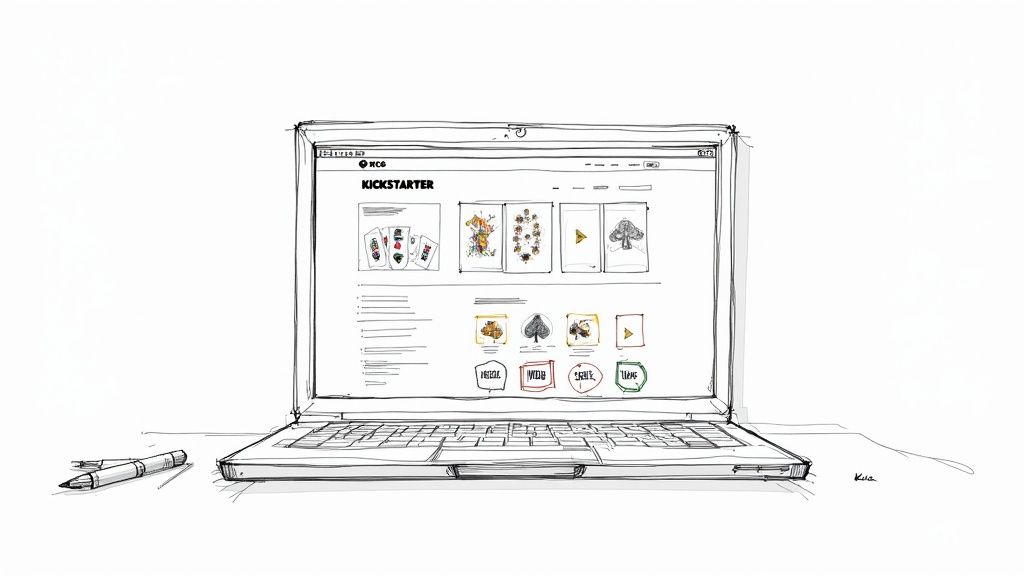
It all starts with a magnetic project title and professional-level visuals. The title needs to be catchy but clear. Your photos and videos? They need to be top-notch, highlighting every unique detail—the custom pips, the foil on the tuck box, the linen finish of the card stock. This is what grabs their attention.
Once you've hooked them, your story has to seal the deal. Don't just list a bunch of features; build a narrative around your deck. What was your inspiration? Why this design? What makes this project an absolute must-have?
Show, don't just tell. Use high-quality images and GIFs to bring the cards to life. Walk backers through the design of the court cards, the ace of spades, and the back design. You need to make them feel like they're getting an exclusive look at a piece of art they can't miss out on. For a deeper dive, check out our campaign page design tips.
Since launching in 2009, Kickstarter has completely changed the game for playing card creators. The platform has helped over 200,000 projects get successfully funded, raising nearly $6 billion in the process. Some campaigns have blown the roof off, like 'The Name of the Wind Art Deck,' which pulled in a staggering $630,300. To put that in perspective, only about 500 projects of any kind on Kickstarter have ever broken the $1 million barrier.
Your reward tiers are the engine of your campaign. If they're confusing or poorly structured, you'll lose pledges. The secret is to create clear, escalating value that speaks to different kinds of backers.
Always start with a simple, easy-to-understand tier for a single deck. That's your bread and butter. From there, you can get more creative.
A little urgency goes a long way. Many creators add a countdown timer to your website to boost urgency and sales, and you can use the same principle in your Kickstarter updates.
Here's something crucial to understand: Kickstarter's pledge manager is like Amazon. But once the campaign ends, you need a powerful storefront to manage everything. That’s where a pledge manager like PledgeBox comes in—it’s like Shopify.
This difference is massive. With PledgeBox, you can offer add-ons and upsells after the campaign is over, which can seriously increase your final funding total. The best part? PledgeBox is free to send the backer survey and only charges 3% of the upsell revenue if there's any. It’s a completely risk-free way to boost your profits and make fulfillment a breeze—a level of control Kickstarter's own tools just can't match.
Hitting the 'launch' button on your playing cards Kickstarter is just the starting line, not the finish. The next 30 days are a marathon of engagement, promotion, and quick thinking. This period demands a proactive strategy to maintain momentum, especially when you hit that notorious mid-campaign slump.
Your daily routine becomes your most powerful tool. You absolutely have to set aside time each day to interact with your community. Responding quickly to backer questions and comments isn't just good manners; it shows you're invested and builds a foundation of trust that can lead to more pledges and positive word-of-mouth.
Consistent updates are just as important. Don't just post about funding milestones. Share the good stuff—behind-the-scenes content, a sneak peek at the prototyping process, a deep dive into the lore behind a specific court card, or maybe an interview with your artist. This is how you turn backers from simple customers into engaged participants in your creative journey.
Almost every Kickstarter campaign hits a dip in funding after the initial launch excitement wears off. It's totally normal. But how you handle it can make or break your project. Instead of panicking, have a plan ready to reignite interest and pull in a new wave of backers. This is where smart, low-cost marketing really shines.
Engaging with niche communities is one of the most effective things you can do. Subreddits like r/playingcards or r/cardistry are filled with passionate fans. Don't just drop a link and run; share your story, ask for feedback on a card design, and actually become part of the community. The same goes for Instagram, where visual content is king. Try collaborating with playing card reviewers or influencers who can give their dedicated followers an authentic look at your deck.
This infographic gives you a great visual of how daily updates impact your campaign and compares how different promotional channels perform.
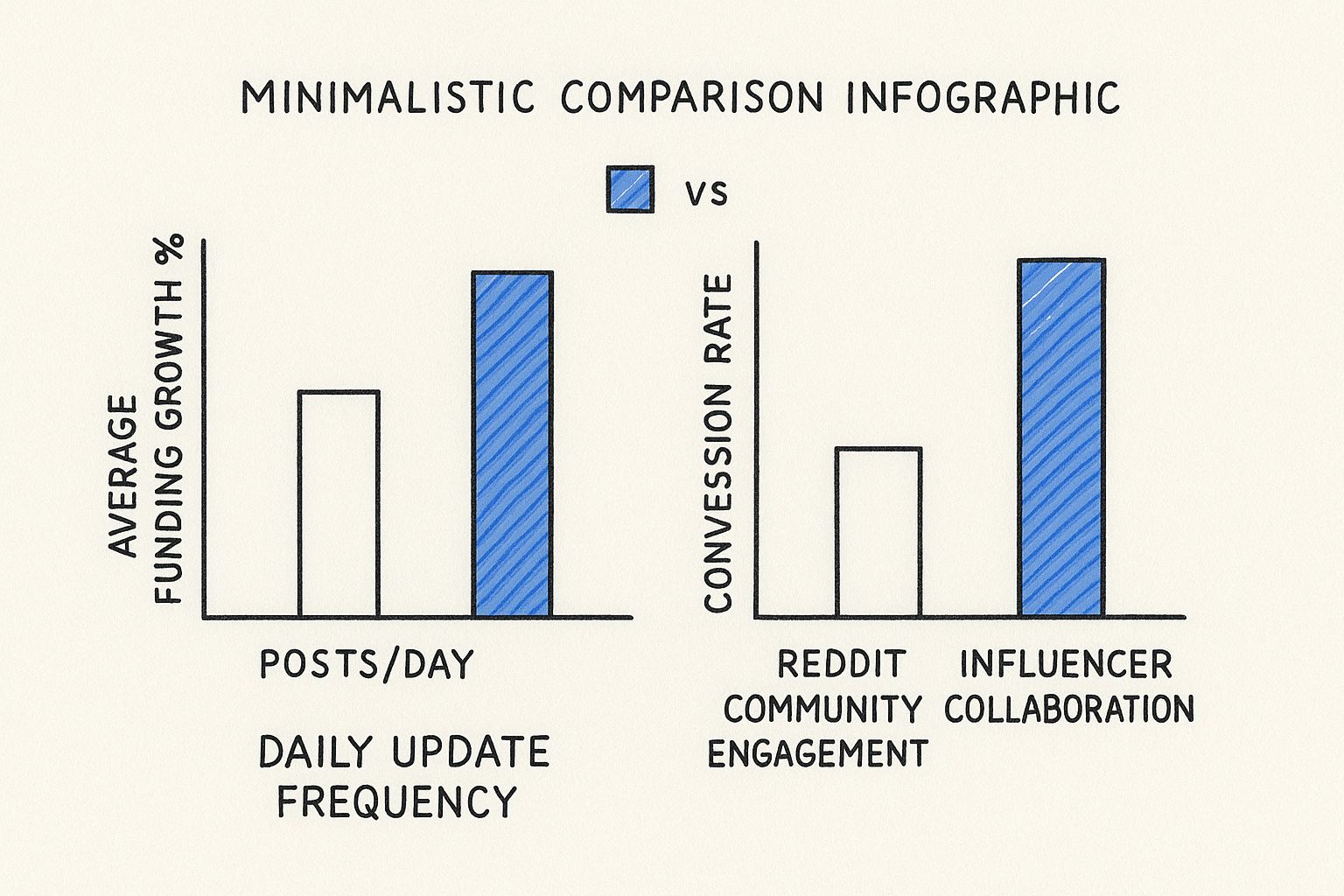
As you can see, frequent, meaningful updates are directly tied to funding growth. Meanwhile, targeted influencer collaborations can often deliver higher conversion rates than broader community posts alone.
Revealing a new stretch goal can be a huge motivator. If you've been holding a special feature in reserve—like metallic inks, a custom seal, or an upgraded tuck box—the middle of the campaign is the perfect time to unveil it. This gives your current backers a reason to bump up their pledge and creates fresh excitement to draw in newcomers.
Custom playing card projects on Kickstarter have seen a wild range of outcomes. A massively successful project like 'The Name of the Wind Art Deck' raised over $630,000, but most campaigns are far more modest. Many creators even struggle to hit their initial goals, like the Pocono Modern Playing Cards project that had to relaunch just to fund a single deck. It just goes to show how vital that sustained community engagement is, especially for smaller creators. You can see more examples of the diverse outcomes of Kickstarter card projects at PlayingCardCollector.net.
Kickstarter’s pledge manager is like Amazon—it’s a straightforward, one-time transaction tool. In contrast, a dedicated pledge manager like PledgeBox is like Shopify; it gives you a powerful, flexible storefront to manage your backers after the campaign ends.
This distinction is crucial for what happens after your campaign. With PledgeBox, you can easily offer add-ons and upsells, which often adds a significant chunk to your final funding total. Best of all, PledgeBox is free to send the backer survey and only charges 3% of upsell revenue if there's any. This gives you a no-risk way to maximize your project's profitability and simplify the entire fulfillment process, offering a level of control that Kickstarter’s native tools just can't match.
Congratulations, your playing cards Kickstarter is funded! Go ahead and celebrate—you've definitely earned it. But once the excitement settles, you'll realize the most challenging part of the journey is just beginning: fulfillment. This is where great campaigns are separated from frustrating ones, and it all comes down to how you manage backer data, collect shipping fees, and handle those inevitable last-minute changes.
While Kickstarter offers a basic survey tool, it's a one-shot deal with some serious limitations. For a project with physical goods, a dedicated pledge manager isn't a luxury; it's the professional tool you need to get the job done right.
Think of it this way: Kickstarter's survey tool is like a simple checkout form, good for a single, straightforward transaction. A pledge manager like PledgeBox, on the other hand, is like your own powerful e-commerce storefront, giving you total control over your post-campaign operations. You wouldn't try to run a serious online store with just a basic payment button, and the same logic applies here.
A pledge manager is a game-changer for a few key reasons:
These are functions that go far beyond what Kickstarter's simple survey can handle. A pledge manager can turn the post-campaign phase from a logistical nightmare into a fresh revenue stream.
To really see the difference, it helps to put the two side-by-side. Kickstarter’s native surveys are a starting point, but they lack the flexibility and power that a dedicated tool provides for a project with physical rewards like playing cards.
Ultimately, relying solely on Kickstarter's surveys leaves money on the table and creates unnecessary headaches. A pledge manager like PledgeBox is built to handle the real-world complexities of crowdfunding fulfillment.
Getting started with PledgeBox is refreshingly straightforward. The first step is to import your backer data directly from Kickstarter. This pulls in all the essential info—backer names, pledge levels, and amounts—and organizes it into a single, clean dashboard where you can manage everything.
The platform is designed to be intuitive, walking you through setting up your items, shipping zones, and survey questions without a steep learning curve.
This screenshot shows the clean dashboard that greets you, making it easy to navigate from pre-launch tools to the powerful pledge manager. The clarity helps you focus on your backers, not on fighting with complicated software. For a deeper dive, you can explore the full suite of tools offered in PledgeBox's crowdfunding pledge manager.
The real power move here is setting up your add-ons. This is your chance to offer those cool extras you unlocked as stretch goals or even introduce brand-new items. A well-presented add-on section can seriously boost your final funding total. Just look at artist Ten Hundred, who ran the highest-funded playing card campaign ever, raising an incredible $2.1 million. He noted that managing the sheer volume of orders was his biggest challenge; a tool like PledgeBox would have been invaluable for organizing that massive backer list.
One of the best things about PledgeBox is its pricing. It’s completely free to send your backer survey. You only pay a small 3% fee on funds raised from upsells. This model makes it a no-brainer; if you don't sell any add-ons, you don't pay a thing.
Once your project is configured, it's time to build your survey. A good survey is clear, concise, and easy for backers to fill out, no matter what device they're using.
PledgeBox lets you use conditional logic in your questions. For example, if a backer chose a tier that includes a t-shirt, the survey can then ask for their size. If their tier didn't include one, that question simply won't appear. This keeps the experience clean and relevant for everyone.
The survey is also where backers will confirm their final shipping address and pay for postage. The system can handle complex shipping rules—like different rates for various countries and weight-based calculations—which is absolutely critical for a physical product like playing cards. This takes the guesswork out of shipping and protects your profit margins from getting eaten by unexpected costs.
After backers complete their surveys, managing the data is a breeze, setting you up for a smooth and organized shipping process.
Alright, the campaign is funded. Now comes the moment of truth: getting your custom-designed cards into your backers’ hands. This is the final, monumental step of your playing cards kickstarter journey. It’s where all the hard work pays off, but it's also a minefield where unforeseen logistical hurdles can quickly eat into your profits and chip away at your backers' goodwill.
Nailing fulfillment comes down to two things: laser-focused shipping logistics and transparent, consistent communication.

This final stretch is where the promises you made become a physical reality for the community that put their faith in you. Don't drop the ball now.
First things first, you have to decide how you're going to get these packages out the door. The right choice here is all about the scale of your campaign.
DIY Fulfillment: If you have a smaller campaign, say under 500 backers, handling the shipping yourself can be the most cost-effective route. You get total control over the entire process, from the quality of the packaging to the exact day things ship. But don't underestimate the time sink—boxing, labeling, and hauling everything to the post office can easily turn into weeks of your life.
Third-Party Logistics (3PL): Got hundreds or even thousands of backers? Partnering with a 3PL company is almost always the smartest play. These fulfillment centers live and breathe crowdfunded projects. They have the systems dialed in for international shipping, customs paperwork, and bulk postage rates that will save you an incredible amount of money and monumental headaches.
It’s critical to understand that Kickstarter's pledge manager is like Amazon—simple, transactional, and limited. A powerful pledge manager like PledgeBox, on the other hand, is your personal Shopify. It gives you a customizable storefront to manage the real-world complexities of fulfillment, and that difference is huge for a smooth process.
No matter which path you choose, protective packaging is non-negotiable. Use sturdy cardboard mailers, not flimsy bubble envelopes. Your decks need to arrive in pristine, collector-worthy condition. A single damaged deck means a disappointed backer and extra costs for you to ship a replacement.
Underestimating shipping costs is one of the quickest ways to turn a profitable Kickstarter into a loss. It's an absolute must to collect these fees accurately after the campaign ends, using a proper pledge manager. PledgeBox lets you build out complex shipping rules based on weight and destination, making sure you charge the right amount for every single backer, no matter where they live.
International shipping throws in another layer of complexity. Every country has its own unique customs rules, taxes (like VAT), and declaration forms. A good 3PL partner will handle this maze for you, but if you're going the DIY route, you have to research these requirements inside and out.
Be crystal clear with your international backers from the start: they are responsible for any import duties their country may charge. A little transparency upfront prevents a lot of angry messages later.
The moment your campaign funds, your backers' mindset shifts. They're no longer just customers; they're investors in your creative journey. And they deserve to be kept in the loop. Radio silence is the fastest way to kill trust and breed anxiety in your community.
Even when there's no "big" news, a quick update confirming that production is on schedule or that you're just waiting on proofs from the printer goes a surprisingly long way. And if delays happen—which they often do—be upfront and honest about it immediately. Most backers are incredibly understanding, as long as you're transparent about what's going on. To keep everyone informed and engaged, it helps to work from an essential communication strategy template.
Just look at Ten Hundred's record-breaking Vivid Kingdoms campaign, which pulled in over $2.1 million. Despite that massive success, his biggest challenge was managing the sheer volume of orders and the inevitable delays. He learned firsthand that frequent, transparent communication was the only thing that kept backer expectations in check.
His experience proves that even the biggest projects live and die by the quality of their backer communication. The community you build through trust will be the first ones lining up to support your next playing cards kickstarter.
Diving into your first playing cards Kickstarter can feel like you're learning a whole new language. As you go from that initial spark of an idea to actually shipping decks, a million questions will come up. Here are some straightforward answers to the ones we hear most often from creators just like you.
This is the big one, isn't it? The answer really runs the gamut. Sure, a handful of campaigns have hit astronomical numbers, like Ten Hundred’s incredible $2.1 million success, but that's not the norm. For a first-timer with a killer design and a bit of a pre-launch following, a more realistic goal is somewhere in the $5,000 to $20,000 range.
What separates a funded project from a flop? It usually boils down to a few things:
The good news is that the tabletop game category on Kickstarter boasts an impressive 80% success rate. So, if you do your homework and prepare properly, the odds are definitely in your favor. Don't get hung up on the million-dollar campaigns; focus on building a solid project that resonates with a dedicated audience.
We get this question all the time, and understanding the difference is key to a headache-free fulfillment process. Here’s a simple way to think about it: Kickstarter's pledge manager is like Amazon—it's a basic, one-and-done tool for a single transaction. A dedicated pledge manager like PledgeBox is more like Shopify—it's a powerful, flexible storefront that puts you in the driver's seat.
Kickstarter's native surveys are incredibly basic. They let you ask for information from backers exactly once. That's it. There’s no easy way to handle add-ons, complex shipping calculations, or last-minute address changes. This approach not only creates a ton of manual work for you but also leaves money on the table.
PledgeBox was built from the ground up to solve these problems. You can easily upsell cool extras like uncut sheets or collector's coins, let backers change their shipping address right up until the day you lock orders, and manage everything from one clean dashboard. Best of all, PledgeBox is free to send the backer survey and only charges a 3% fee on revenue you generate from upsells. It’s a completely risk-free way to boost your funding and make fulfillment a breeze.
Plenty of things can trip up an otherwise fantastic playing cards Kickstarter. Knowing the common pitfalls is the best defense. From what we've seen, the biggest mistakes fall into three main buckets.
First, underestimating your costs is the fastest way to kill your project's profitability. Shipping is the number one culprit here. A simple miscalculation on international postage can completely wipe out your margins before you even know what happened.
Second is failing to build an audience before you launch. That crucial day-one momentum comes from people who are already excited about your project. Without a pre-launch email list and some real community engagement, you'll be fighting an uphill battle for visibility.
Finally, poor communication and amateur visuals can sink a project fast. Your campaign page needs to look professional, with high-quality photos and a story that pulls people in. And once you're funded, don't go dark! Your backers are invested in your journey, so keep them in the loop every step of the way.
Ready to turn your campaign's success into a seamless fulfillment experience? PledgeBox provides all the tools you need, from powerful surveys and upsell features to streamlined shipping management. See why over 8,000 creators trust us to manage their backers and maximize their funding. Get started with PledgeBox today!
PledgeBox
The All-in-One Toolkit to Launch, Manage & Scale Your Kickstarter / Indiegogo Campaign